In a recent webinar with our partners at Codemill, Vionlabs founder Arash Pendari and Codemill’s Andreas Stockinger walked through how AI-powered content segmentation is reshaping media operations, replacing tedious manual work with intelligent, semi-automated workflows. Listen to the full webinar recording here.
The Problem: Manual Segmentation Doesn’t Scale
Streaming platforms today need frame-accurate markers across their entire catalogues - skip intro, recap detection, end credits, ad break positions - and someone has to find them all.
A single episode can take 15 to 30 minutes to segment manually. Multiply that across a library of thousands of titles, and you’re looking at an enormous operational bottleneck.
The question isn’t whether these markers matter. They’re critical for platform features, user experience, and monetisation. The question is how to do it at scale without burning out your operations team.
And the stakes are higher than most teams realise. A 2025 study from the University of Chicago found that when Netflix users disabled autoplay, their average viewing session dropped by about 18 minutes. That’s the measurable impact of a single transition point between episodes. Features like skip intro, binge markers, and smart ad breaks all depend on the same thing: accurate, frame-level segmentation data. Without it, you’re leaving watch time on the table.
How Vionlabs AI Detects Programme Elements
Vionlabs has built AI models specifically trained on entertainment content to automatically detect key programme elements: intros, recaps, credits, previews, and optimal ad break positions.
Ad Break Detection: Four Models Working Together

What makes Vionlabs’ approach to ad breaks unique is that it’s not just one model making a guess. It’s four specialised AI models working in concert:
- Shot similarity: ensuring scenes on either side of the break are distinct from each other
- Scene boundary detection: confirming there’s a clear scene cut
- Dialogue awareness: avoiding breaks that interrupt conversation
- Story awareness: understanding narrative intensity so breaks don’t land in the middle of a suspenseful moment
When all four models agree, the ad break is rated excellent. Three out of four? Good. Fewer? Passable. All are usable, but the rating system lets operators make fast, confident decisions about which positions will deliver the best viewer experience.
During the webinar, Arash and Andreas demonstrated this in real time on a 40-minute episode, mapping out four to five ad breaks in under a minute by simply following the AI’s ranked recommendations, rather than scrubbing through the entire episode manually.
Intro, Credit & Recap Detection: Built for Global Content
The intro and credit detection model is trained to understand the recipe of these programme elements, not just surface-level cues like “previously on” text cards.
A recap, for example, is recognised as a sequence of scenes cut together with music playing over them, regardless of whether it explicitly announces itself. This matters because content varies enormously across regions:
- Korean dramas can feature advertisements within credit sequences, background scenes playing behind credits, or flashback montages instead of traditional name rolls.
- Japanese anime often has unique credit structures that differ from Western conventions.
By fine-tuning the model across a wide variety of content types and regions, Vionlabs achieves high accuracy that scales globally, not just for US or European content.
Semi-Automation: AI Does the Heavy Lifting, Humans Make the Calls
The philosophy behind this workflow is straightforward: humans shouldn’t be doing repetitive factory-line work. They should be focusing their energy on creative decisions.
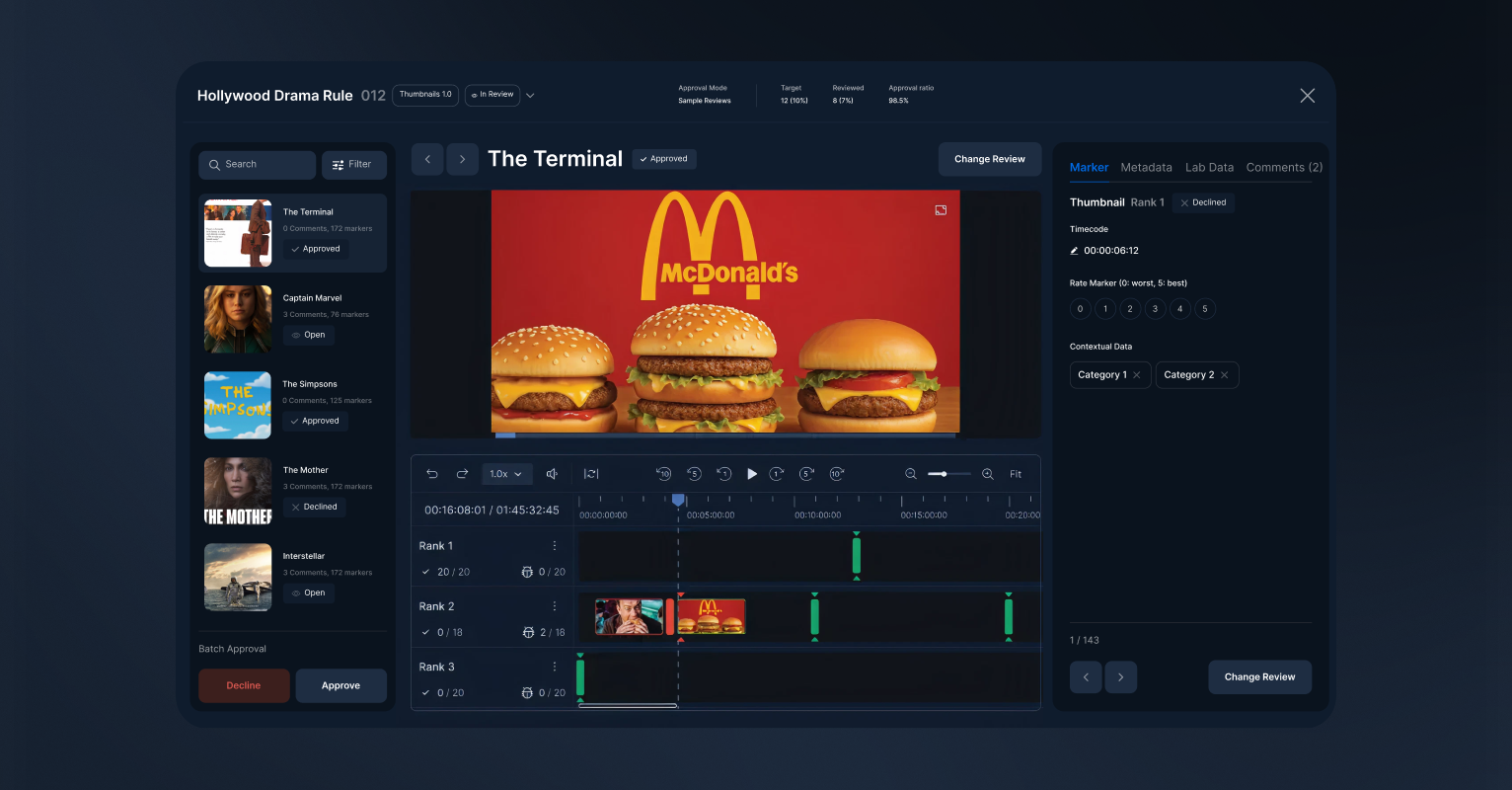
Vionlabs’ AI handles the bulk detection, processing entire libraries and generating time-based metadata for every asset. Operators then review and validate the results using tools like Codemill’s Accurate Video, where they can loop scenes, compare ranked recommendations, and approve markers in a fraction of the time manual processes require.
The result is a shift from watching every minute of every episode to reviewing only the moments that matter.
Why This Matters: The Direct Impact on Watch Time
Every piece of content segmentation metadata ultimately serves one purpose: keeping viewers engaged without frustrating them.
The evidence that reducing friction between episodes drives watch time is now well-documented. The University of Chicago autoplay study mentioned above is one of the clearest examples: removing a single automated transition point cost viewers roughly 18 minutes per session. That’s the baseline value of frictionless episode-to-episode flow. Now consider what happens when you stack multiple friction-reducing features on top of each other.
Skip intro buttons let viewers bypass a 60-to-90-second opening they’ve already seen, removing a natural drop-off point. Recap detection means returning viewers are caught up in seconds rather than rewatching content or, worse, losing the thread and abandoning the series entirely. Binge markers that accurately detect where credits begin allow platforms to trigger the next-episode countdown at exactly the right moment - not too early, which feels aggressive, and not too late, which loses the viewer to their phone.
Ad breaks have a similar compounding effect. When an ad interrupts a conversation or a tense scene, viewers feel it - and some won’t come back. When the break lands at a natural scene transition, it feels like a pause rather than an intrusion. Vionlabs’ own data shows a 46% reduction in churn when ad breaks are placed using AI-optimised, story-aware positioning versus standard fixed-interval insertion.
None of these features work without accurate, frame-level segmentation data. And none of them scale without AI.
Beyond Ad Breaks: Chapters, Preview Clips, and Thumbnails
The webinar also showcased Vionlabs’ chapter and topic model, which breaks long-form content into structured segments based on what’s actually happening on screen.
Using a MasterChef episode as an example, the AI automatically identified distinct sections, from individual contestant segments (“Linda’s dish,” “Emily’s dish”) to recurring show elements like the apron ceremony, complete with descriptions of what’s happening in each section and keyword tags.
But the intelligence doesn’t stop at chapters. The same scene-level understanding that powers segmentation also feeds directly into Vionlabs’ Creative Lab, where it’s used to generate preview clips and thumbnails. Because the AI knows which moments carry the most emotional weight, which characters appear in which scenes, and what the mood of each segment is, it can automatically select and generate visual assets that drive click-through and engagement.
- Preview clips that capture the most compelling moments of an episode, matched to specific moods or themes using creative recipes
- Thumbnails that feature the right characters in the right emotional context - not just a random frame, but a frame that makes viewers want to click
- Short-form content for social media and YouTube, with AI-generated titles, descriptions, and SEO-friendly keywords based on scene-level metadata
This scene-level intelligence also opens up practical use cases across the broader content lifecycle:
- Trailer and promo editing: instantly locate the most compelling moments without watching entire episodes
- Recap creation: find evaluation scenes, key dramatic moments, or winner announcements in seconds
- YouTube and social media publishing: use AI-generated clips with titles, descriptions, and keywords ready to go
- Content indexing: make every scene searchable and actionable across the library
The common thread is that one AI analysis pass produces intelligence that serves editorial, creative, marketing, and operations teams simultaneously - from a single source of truth.
What’s Next
Arash hinted at several areas on the roadmap, including live feed processing for FAST channels, brand safety analysis combined with ad break positioning, and deeper contextual scene-level data, all aimed at giving media operations teams even more intelligence to work with, faster.
Want to hear the full conversation? Listen to the webinar recording.
Ready to see how Vionlabs AI can accelerate your content segmentation workflows? Book a demo to see it in action.
.png)
.png)