
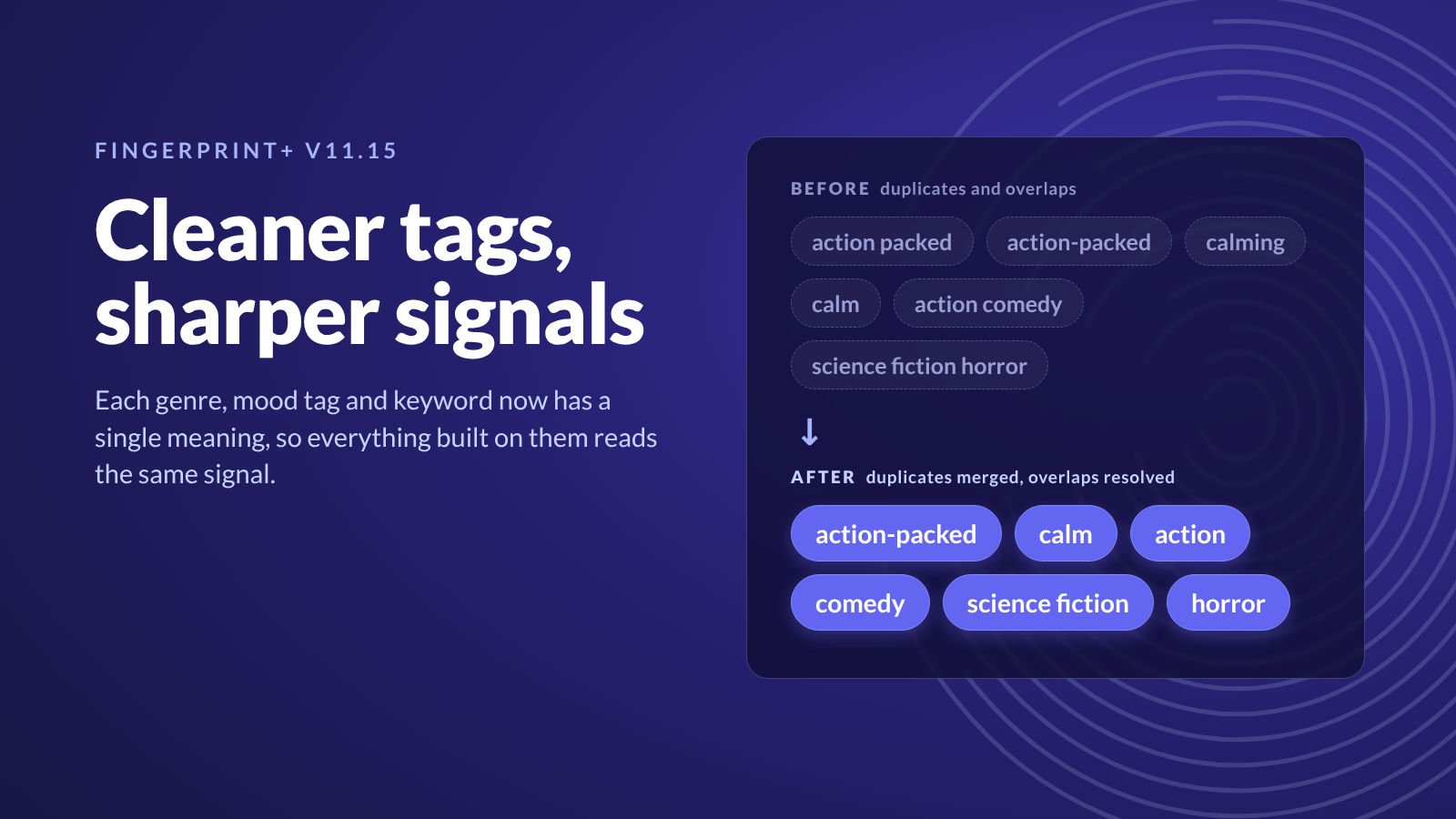
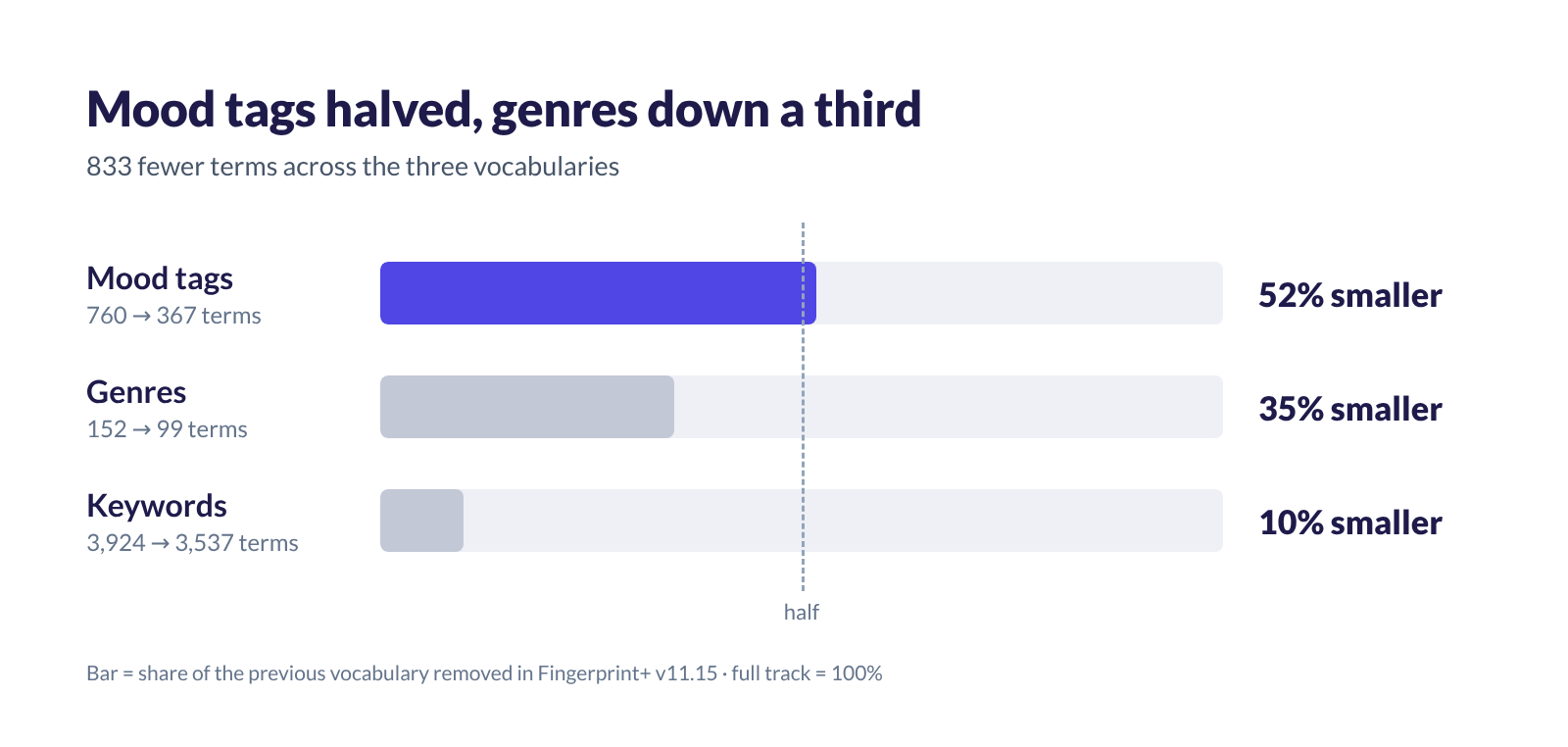
Fingerprint+ v11.15 trims 833 terms from its genre, mood and keyword vocabularies, adds Arabic tags and synopses, and stops forcing tags into synopses. Here's what changed and why it matters.
Why a Smaller Vocabulary Makes Better Metadata
Metadata vocabularies tend to grow, because every new term looks like extra coverage. Past a certain size, though, new terms start to overlap with existing ones, and the vocabulary becomes harder to work with.
Our genre list had 152 terms. Building a rail from it meant deciding whether a title belonged under action comedy or under action and comedy. Mood tags, with five times as many terms, had the same problem: a curator filtering on calm would miss titles tagged calming. When one idea is split across two labels, any search filter or recommendation that uses one of them sees only part of the relevant titles.
For v11.15 we rebuilt all three vocabularies, starting from customer feedback and applying one rule throughout: when two labels mean the same thing, or one overlaps another, only one of them stays.
A Leaner, Sharper Vocabulary
All three vocabularies are smaller in v11.15, and each one was cleaned up in a different way.
Genres: No More Overlap
Genres no longer overlap. Compound labels such as action comedy and science fiction horror have been removed, and titles that carried them are now tagged with the parent terms: action and comedy, or science fiction and horror.
To find action comedies, filter on both action and comedy. You no longer need to know which compound labels exist or which one a particular title was given.
Mood Tags: One Spelling per Feeling
Duplicate spellings and near-synonyms have been collapsed into a single form:
- action packed and action-packed → action-packed
- calming and calm → calm
Theme nouns such as redemption and nostalgia have moved from mood tags to keywords, since they describe what a story is about, which is what keywords are for.
Keywords: Focused on the Story
The keyword vocabulary is the previous core set with the overlapping terms removed, and no new terms have been added. Genre words, mood tags, eras, places and franchise names are no longer keywords, so the keywords that remain describe what a story is about. If you currently filter on eras, places or franchises through keywords, those filters will need to change.
Fingerprint+ in Arabic
Fingerprint+ tags and synopses are now available in Arabic. Viewers search and browse in their own language, so platforms serving Arabic-speaking audiences can now use Arabic metadata directly, with no translation step on their side.
Synopses That Lead With the Story
In v11.15, synopses lead with the story, and mood tags appear only where they fit naturally.
Previous versions of Fingerprint+ worked genres and mood tags into the synopsis. That made sure the metadata appeared, but it also made synopses read like a list of tags with a story attached. Here is Apollo 13 before and after:
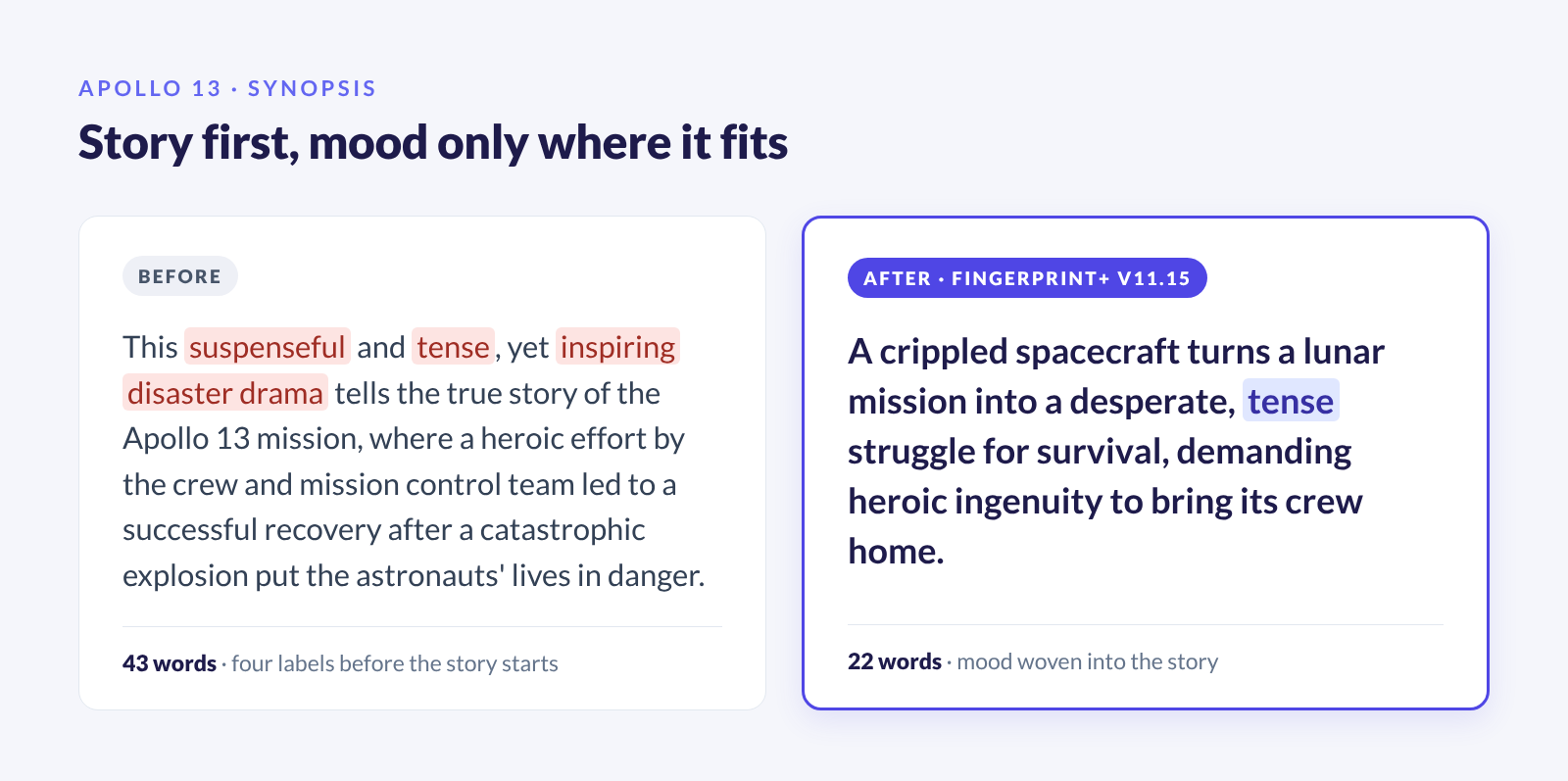
The old version puts four labels (suspenseful, tense, inspiring and disaster drama) ahead of the story. The new one opens with the stakes and uses mood words such as tense inside the description itself. In this example it is also about half as long, at 22 words against 43.
Genres and mood tags are still delivered in full as structured metadata, so the synopsis no longer needs to carry them and can be written to interest a viewer in the title.
What This Means for Customers
Fingerprint+ v11.15 is available now. Because it changes vocabularies that your rails and filters may depend on, these are the changes to check:
- Compound genres are retired. Anything built on labels like action comedy should use the parent terms instead, for example action and comedy together.
- Mood-tag duplicates are merged. Retired spellings and near-synonyms fold into the form that remains, such as calm for calming.
- Theme nouns are keywords now. Terms like redemption and nostalgia are no longer mood tags.
- Eras, places and franchise names have left the keyword vocabulary. Filters that rely on them through keywords will need updating.
- Synopses use the new format. If you show synopses in fixed-length slots, check how the new style fits.
Your Vionlabs contact can walk you through the changes and help you map old terms to new ones.
We removed 833 terms because a taxonomy is only useful when it is consistent: every tool built on top of it depends on each term meaning the same thing wherever it appears.
We build and continuously improve our own AI models, trained specifically on entertainment content. This release is based on what customers told us about working with the previous vocabularies.
New to Vionlabs? Book a demo → and see what Fingerprint+ finds in your catalog.
.png)
.png)