The most important infrastructure decision in entertainment today isn't which streaming platform to build on, which CDN to optimize, or which recommendation engine to fine-tune.
It's whether your content is actually understood.
Across media and entertainment, companies are sitting on enormous libraries of films, episodes, documentaries, trailers, and short-form assets. Yet most of that content remains operationally invisible because it lacks an intelligent content layer.
This is no longer just a metadata problem.
It's a monetization problem.
A discoverability problem.
A retention problem.
And increasingly, a competitive problem.
What "content understanding" actually means
Content understanding is the layer that sits between your raw video assets and every product decision you make on top of them: what to recommend, what to merchandise, what to surface, what to monetize, what to license, what to schedule.
It is not the same as video tagging. It is not the same as transcription. And it is not the same as generic "video AI."

True content understanding answers questions a human viewer cares about:
- What is this content actually about, beyond its genre label?
- What mood does it evoke, and where does that mood shift?
- Which scenes carry emotional weight, and why?
- Where does the story turn, accelerate, or slow down?
- What makes this title feel similar to that other title, even though they sit in different categories?
When a platform can answer these questions automatically and at scale, every downstream system gets sharper: recommendations, search, thumbnails, previews, ad placement, editorial curation, licensing decisions, and FAST channel programming.
When a platform cannot answer these questions, every downstream system runs on assumptions, manual tagging, and broad genre buckets. That is where most of the industry is today.
The content explosion has outpaced content intelligence
Entertainment libraries have never been larger. Studios, broadcasters, FAST channels, OTT platforms, and rights holders are managing more content than ever, including feature films, episodic series, franchise catalogues, promotional clips, trailers, AVOD and FAST programming, and entire international localization libraries.
And most of it is still organized the same way it was a decade ago: static metadata, manual editorial tagging, broad genres, and surface-level categorization.
That framework was sufficient when catalogues were smaller and audience expectations were narrower. It is no longer sufficient when modern viewers expect hyper-personalized discovery, scene-level search, mood-based recommendations, dynamic thumbnails, personalized preview clips, and contextual merchandising, all the time.
Today's audience does not just want to find "a comedy."
They want a feel-good workplace sitcom. A dark psychological thriller with slow pacing. A documentary that hits a specific emotional register. A scene that matches their mood in the moment.
If your platform cannot understand content at that level, you are leaving engagement, retention, and revenue on the table.
Why content understanding is core infrastructure, not a feature
Many media executives still view advanced AI as an "enhancement layer," something that improves the experience around an otherwise traditional content stack.
This is the wrong way to think about it.
Content understanding is becoming core infrastructure. The companies that integrate it now will build durable advantages across five areas at once:

Discovery. Move beyond title, cast, and genre into mood, themes, scene dynamics, emotional arcs, and contextual recommendations.
Personalization. Generate dynamic thumbnails, preview clips, and merchandising experiences that materially improve click-through rate and watch time, at scale, across an entire catalog.
Content operations. Automate metadata enrichment, scene indexing, content summarization, binge-marker detection, and creative asset generation. What used to take editorial teams weeks now happens in hours.
Retention. Deliver more relevant recommendations and reduce churn through deeper audience-content matching, across both new releases and the long tail.
Monetization. Enable contextual advertising, smarter FAST channel programming, more efficient licensing, and better-performing promotional campaigns.
The shift is not from "no AI" to "some AI." It is from AI as a feature to AI as a foundation.
Why "video understanding" is not the same as content understanding
Much of the industry's AI conversation right now centers on video understanding, extracting what's literally on screen: objects, faces, transcripts, scene boundaries.
That is useful. It is also not the same thing as understanding the story.
Entertainment is not a logistics problem. It is an emotional one. A viewer doesn't choose a film because it contains "two people in a kitchen." They choose it because of how it feels: the pacing, the mood, the emotional arc, the tone of the dialogue, the moment that hooks them in episode three.
This is the layer Vionlabs has spent nearly a decade building. Our domain-specific AI is trained specifically on entertainment content, which means it understands stories, characters, emotions, and structure the way a human viewer does. Not just what is in the frame, but what the frame means.
That is the difference between detecting "a beach scene" and recognizing "a quiet, melancholic moment of reflection on the coast." Both are technically correct. Only one helps you merchandise, recommend, or monetize.
This distinction is the heart of the infrastructure decision. A platform built on video understanding alone will always need a human layer on top to translate raw signals into product value. A platform built on content understanding closes that gap.
This is not experimental technology
For many executives, AI in content strategy still feels early-stage or experimental.
That perception is outdated.
Content understanding is already deployed at scale across some of the largest media businesses in the world. At Vionlabs, our platform runs across millions of hours of video for leading broadcasters and streaming platforms, including Paramount+, Hulu, Plex, Deutsche Telekom.
Our platform already enables:
- Deep metadata enrichment with mood, theme, and emotional context
- Scene-level content intelligence
- AI-generated thumbnails matched to mood and tone
- Dynamic preview clip generation
- Editorial curation with auto-generated lists, names, and descriptions
- Ad-break detection optimized for viewer retention
- Binge-markers (intro, recap, end-credit) at scale
- Contextual advertising powered by scene-level metadata
The competitive question is no longer if this technology works. It's who operationalizes it first, and how broadly across the business.
The infrastructure decision in front of every media company
Entertainment companies are currently making one of two strategic choices:
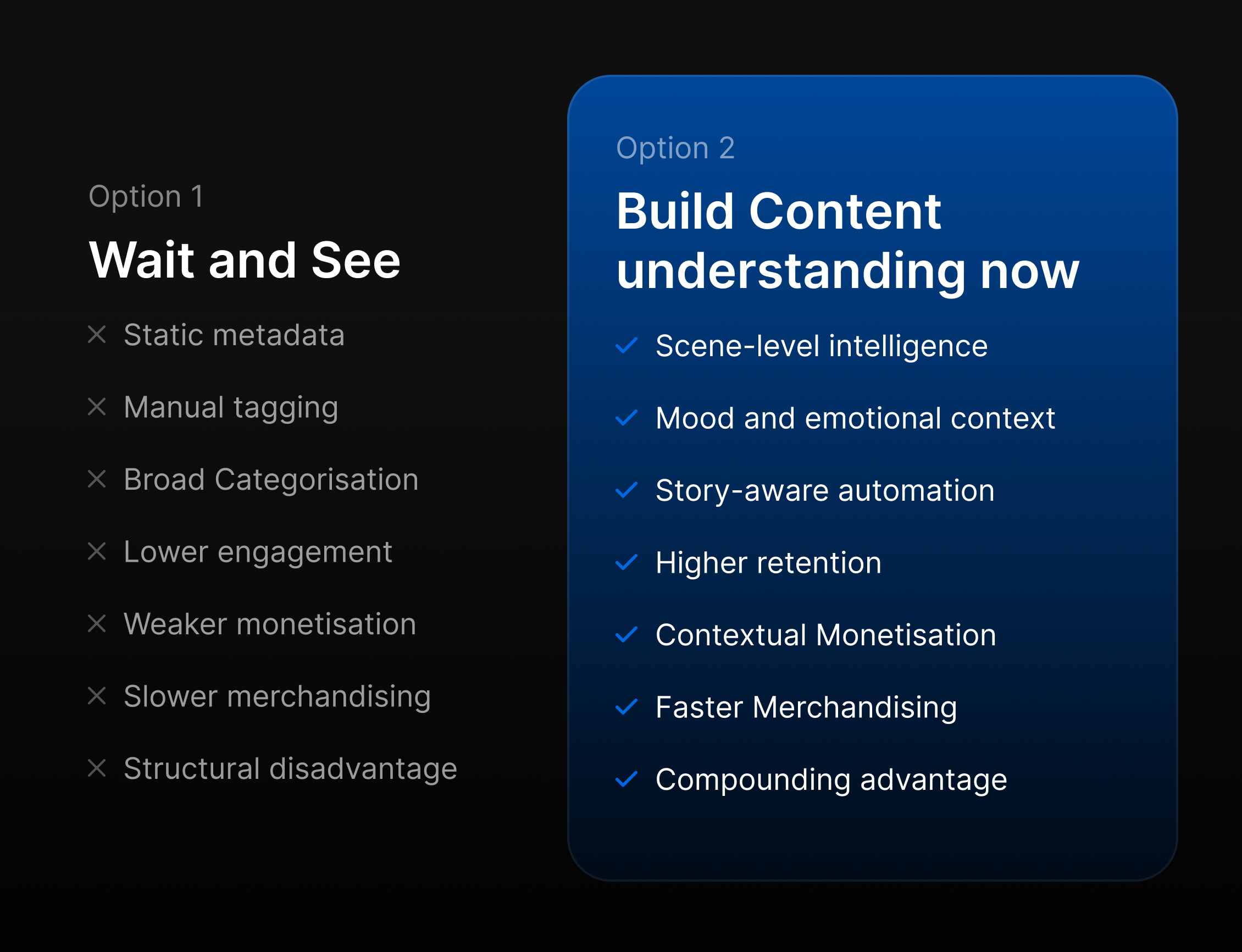
Option 1. Treat content understanding as a future initiative. Continue relying on static metadata, manual tagging, and broad categorization. Wait until the technology becomes "table stakes" before committing.
Option 2. Build a content understanding layer now. Use that foundation to compound advantages in retention, engagement, monetization, licensing, and operational efficiency over the next several years.
The companies choosing Option 1 are not standing still. They are losing ground, quietly, every quarter.
The cost of waiting is not the cost you save by delaying. It is the revenue that doesn't exist yet because your catalog is not ready to capture it: the contextual ad placements you can't sell, the licensing opportunities your team can't surface, the personalized experiences your competitors are already shipping.
As content-understanding-native platforms mature, lagging organizations will face lower engagement, weaker monetization, slower merchandising, inferior user experiences, and a structural competitive disadvantage that gets harder to close every month.
The bottom line
The future leaders in entertainment will not simply own great content.
They will own the infrastructure that understands it best.
Content understanding is rapidly becoming one of the most consequential strategic decisions in media. It sits underneath every recommendation, every thumbnail, every ad break, every licensing deal, and every personalized experience. Get it right, and the entire content business compounds. Get it wrong, or wait too long, and the gap widens with each quarter.
This is the infrastructure decision that will define the next decade of entertainment.
The companies that treat it that way will define the next generation of media experiences. The ones that don't will spend the next decade trying to catch up.
Ready to see what content understanding looks like in your library?
Vionlabs powers content understanding for leading broadcasters and streaming platforms worldwide. Book a demo →
.png)