
There is a format shift underway in the entertainment industry that is bigger, faster, and more commercially significant than most broadcasters, studios, and streaming platforms have yet acknowledged. Vertical video – content built natively for the portrait screen that most people hold in their hand for several hours a day – is no longer a social media curiosity. It is becoming the primary way a generation of viewers consumes entertainment. And for companies that have spent decades building horizontal content libraries, the question is no longer whether to act. It is how to act fast enough, and at the scale required, to stay relevant.
The Numbers Are Impossible to Ignore
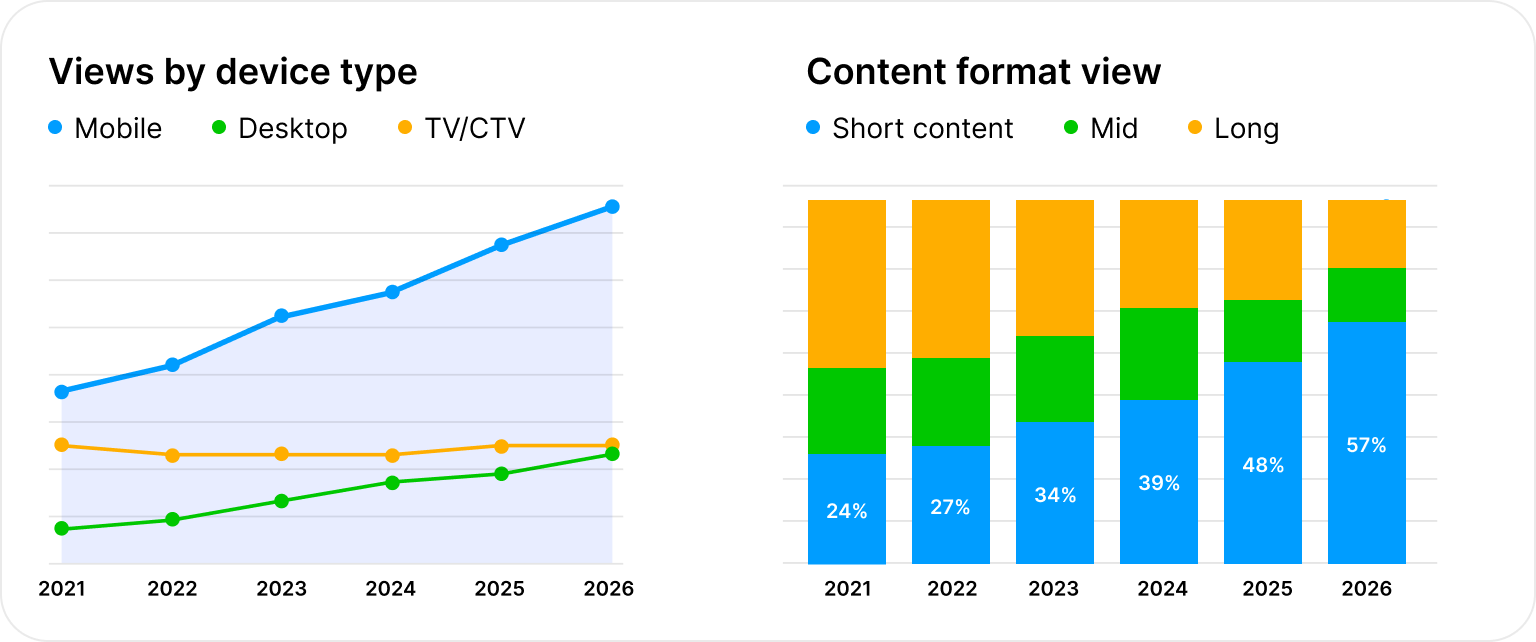
Start with the behaviour. Today, 71% of all online video views happen on mobile devices, and around 90% of smartphone users prefer watching content in portrait mode. They have stopped rotating their phones – the vertical scroll is the default, and content that does not fit it gets skipped.
The engagement difference is not marginal. Vertical videos generate 58% more engagement on mobile than horizontal equivalents. Platforms have noticed. YouTube now supports simultaneous vertical and horizontal broadcasts and launched AI-powered tools that automatically convert long-form content into vertical Shorts – a clear signal of where growth is heading.
The microdrama numbers make the urgency impossible to ignore. Short drama app downloads surpassed 2.3 billion globally in 2025, more than doubling year over year. Global microdrama revenue hit $11 billion in 2025, projected to reach $14 billion in 2026. In China, the format surpassed domestic theatrical box office revenue in 2024 – going from $500 million in 2021 to over $7 billion in four years. International markets are earlier in that cycle, but moving fast: Latin America saw short drama downloads rise 69% quarter-over-quarter in Q1 2025 alone.
And perhaps the most striking data point of all: ReelShort users in the US now spend an average of 35.7 minutes per day on the app. Netflix clocks 24.8 minutes. Disney+ comes in at 23. Netflix still leads in overall monthly users by a wide margin – but engagement intensity tells a different story about where mobile viewing habit is actually forming.
The mobile-first entertainment revolution is not coming. It is here.
What Is Driving This – and Why It Matters for Broadcasters, Studios, and Streamers
The microdrama boom is the most visible expression of a deeper shift, but it is not the only force driving urgency for traditional media companies.
For audiences under 35, the social feed is the new TV guide. Content that does not appear as a vertical clip on TikTok, Instagram, or YouTube Shorts often does not get discovered at all. The algorithm rewards native vertical content – and what gets recommended gets watched. Meanwhile, short-form is reshaping expectations across all content. Netflix has already introduced series under 15 minutes per episode. The pressure to produce vertical previews, short promos, and chapter-based experiences from long-form libraries is real and growing.
The monetisation case is getting stronger too. With over 50% of consumers having switched to cheaper ad-supported tiers and AVOD revenue projected at $81.2 billion, vertical content is increasingly a revenue opportunity in its own right – not just a marketing cost. Vertical clips that drive app downloads and carry contextual advertising are a genuine income stream.
And the geographic pipeline is accelerating. Fox, Cineverse, and Access Entertainment have all entered the microdrama space. What started in Asia is globalising faster than most incumbents have planned for.
The strategic implication is straightforward: the libraries broadcasters and studios have already built contain enormous untapped value in vertical format. The question is how to unlock it.
What Broadcasters and Streamers Need to Do to Tap In
Participating in the vertical video opportunity requires more than cropping a few clips. To monetise at scale, media companies need four things working together.
Vertical preview clips and promos for social and promotion. Every piece of long-form content should be generating vertical clips – dramatic moments, character introductions, narrative turns – formatted natively for social. These clips promote the content to audiences who would never see a traditional trailer, and they carry advertising value in their own right. A broadcaster with 10,000 hours of content is sitting on a social library of enormous potential – if they can extract it efficiently.
Metadata as the engine of personalisation and recommendation. The vertical feed is algorithmically driven. What surfaces is determined by metadata – mood, genre, scene type, theme – mapped to what a viewer has engaged with before. Title-level metadata is not sufficient. Scene-level intelligence is what gets the right clip in front of the right person at the right moment.
Verticalisation of long-form content into chapters and micro-episodes. Long-form libraries contain the raw material for verticalised chapter experiences – but extracting it requires understanding story structure, identifying moments of narrative tension, and assembling chapters that work as standalone vertical content while drawing the viewer into the full piece. This is a content intelligence problem, not a simple edit.
Contextual advertising within vertical formats. Vertical content creates new advertising inventory – but only if it is contextually appropriate. Serving the right ad against the right scene type and audience signal requires the same metadata infrastructure that powers recommendation. The opportunity is growing fast as brands follow audiences onto mobile-first platforms.
Why Scale Is the Real Challenge – and Where AI Comes In
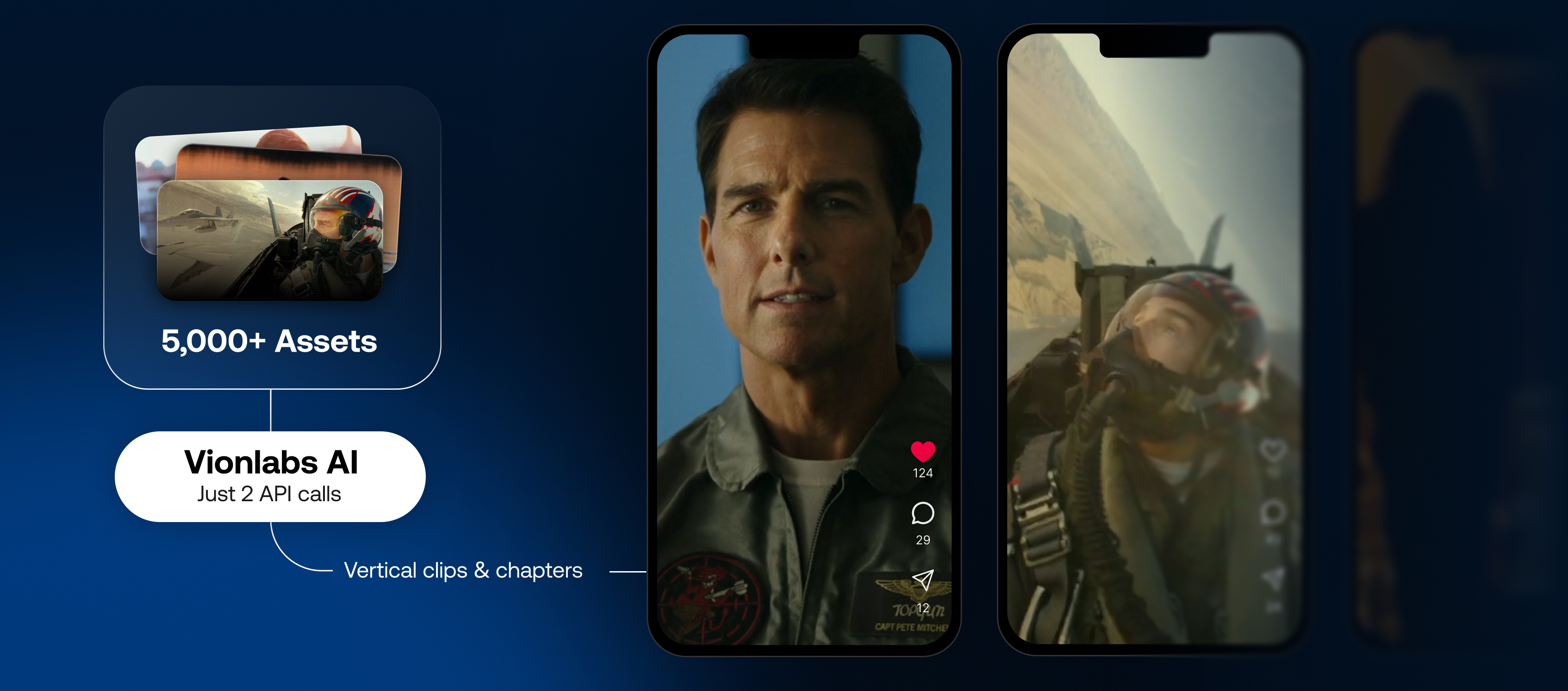
This is where most conversations about vertical video stall. A broadcaster with 5,000 assets cannot verticalise them one by one. The manual production cost would be prohibitive, the quality inconsistent, and the speed nowhere near fast enough to stay relevant in a feed that refreshes constantly.
We see clients coming to us wanting to verticalise thousands of assets simultaneously. At that scale, it stops being a production question and becomes a technology question.
Scene-level content understanding is the foundation. Which scenes carry the most emotional weight? Which moments are most likely to drive engagement as a standalone clip? Without scene-level understanding across a full library, you are guessing. With it, you can search, filter, and extract with precision at scale.
Mood and emotion search matter more than most people expect. The most powerful vertical clips are not always the loudest moments – they are the ones that hit an emotional chord. Finding those across thousands of hours requires the ability to search on mood: tension, warmth, humour, melancholy. This is foundational to producing content that actually performs in the vertical feed.
Story-aware AI, not just face-aware AI. Most vertical cropping technology follows the dominant face in frame. For an interview, that works. For a drama or a thriller, it misses the point entirely. The relevant subject in a given moment might be a reaction shot, an object, a detail the director has deliberately foregrounded. Understanding what matters in a scene requires an AI that understands story – what the scene is about, what the viewer's attention is being drawn toward.
At Vionlabs, our AI is trained to be story-aware. It understands narrative structure, scene function, and emotional arc – not just visual composition. That distinction matters enormously when the goal is not just to crop content but to surface the moments within it that will resonate with a mobile audience scrolling at speed.
Cropping technology trained on entertainment, not generic video. A slow-burn drama requires different framing choices than an action sequence. A romantic scene has different compositional logic than a confrontation. Cropping technology built for entertainment needs to be trained on the specific visual grammar of the content it is being applied to – with face recognition, body language, environmental context, and edit rhythm all playing a role.
Chapters – making long-form work in a short-form world. A 45-minute drama contains multiple self-contained story beats – moments of crisis, revelation, humour, romance – each of which could function as a vertical episode if extracted intelligently. Creating chapters requires understanding narrative architecture: where acts begin and end, which scenes can stand alone, how to shape a satisfying short-form piece without losing coherence. Done well, chapters do not cannibalise long-form content – they create a new entry point into it.
The Mobile-First Revolution Has Just Started
Short drama app downloads surpassed 2.3 billion in 2025. Microdrama revenue is projected to reach $14 billion in 2026 and potentially $20–30 billion by 2030. Traditional streaming app downloads fell 4% in 2025 while short drama downloads grew more than 100%. The direction is clear.
What comes next – interactive vertical storytelling, AI-generated personalised episodes, immersive mobile formats – is genuinely exciting to think about. But for studios, broadcasters, and streaming platforms, the more pressing question is whether they have the capabilities today to participate in a shift that is already generating billions and reshaping how audiences find and watch content.
The libraries are there. The content value is there. The audiences are there – scrolling, searching, spending more time in vertical formats than on Netflix. What is missing, for most incumbents, is the AI infrastructure to extract that value at the speed and scale the moment demands.
The mobile-first opportunity does not wait for roadmap cycles. We think we have the answer to how you move fast enough to capture it – and we would love to show you how.
Vionlabs is an AI-powered content intelligence platform helping broadcasters, studios, and streaming services unlock the value in their video libraries – from scene-level metadata enrichment and vertical clip generation to contextual ad matching and story-aware cropping at scale.
.png)
.png)