

The most important pixel real estate on your platform
Before a viewer presses play, before they read a title, before they check a rating – they look at the thumbnail. Research consistently shows that approximately 80% of the viewing decision on streaming platforms is made on the basis of the thumbnail alone. It is the single highest-leverage touchpoint in the entire content discovery journey.
Now consider how most platforms actually select those thumbnails. Manual picks by an editor who watched the content once. Automated frame grabs at a fixed timestamp. Rule-based systems that pull frame number X from every asset regardless of what's in it. For the investment that goes into content acquisition, production, and marketing – the last inch of that journey is often left almost entirely to chance.
Three approaches. Three failure modes.
01 – Manual Selection. A human editor watches content and picks a frame that looks 'good'. Failure: Inconsistent. Unscalable. Relies on individual taste. Long-tail content often gets nothing.
02 – Random Frame Grab. An automated system grabs a frame at a fixed point – often mid-cut or mid-blink. Failure: Optimizes for nothing. High chance of black frames, motion blur, or irrelevant shots.
03 – Rule-Based (e.g. 10%). System always picks the frame at 10% of runtime. Marginally better, still emotionally blind. Failure: Predictable positioning, but zero signal about what the frame actually communicates.
The common thread: none of these methods carry any signal about what a frame makes a viewer feel. And feeling is everything when someone has half a second to decide whether to keep scrolling or press play.
What emotion AI actually does – and why it's different
Emotionally salient frames are not the most visually dramatic frames. They are not the biggest explosion, the widest establishing shot, or the most technically composed image. They are the frames where facial expression, body language, and scene context combine to create the strongest emotional signal for that specific content type and target audience.
Vionlabs' emotion AI scans every frame of every asset in your library – identifying where those signals peak. The model understands emotional valence, arousal, character prominence, and scene context simultaneously. It does not guess. It measures.
Case Study 1 – The High-Arousal Face Effect: What the Data Shows
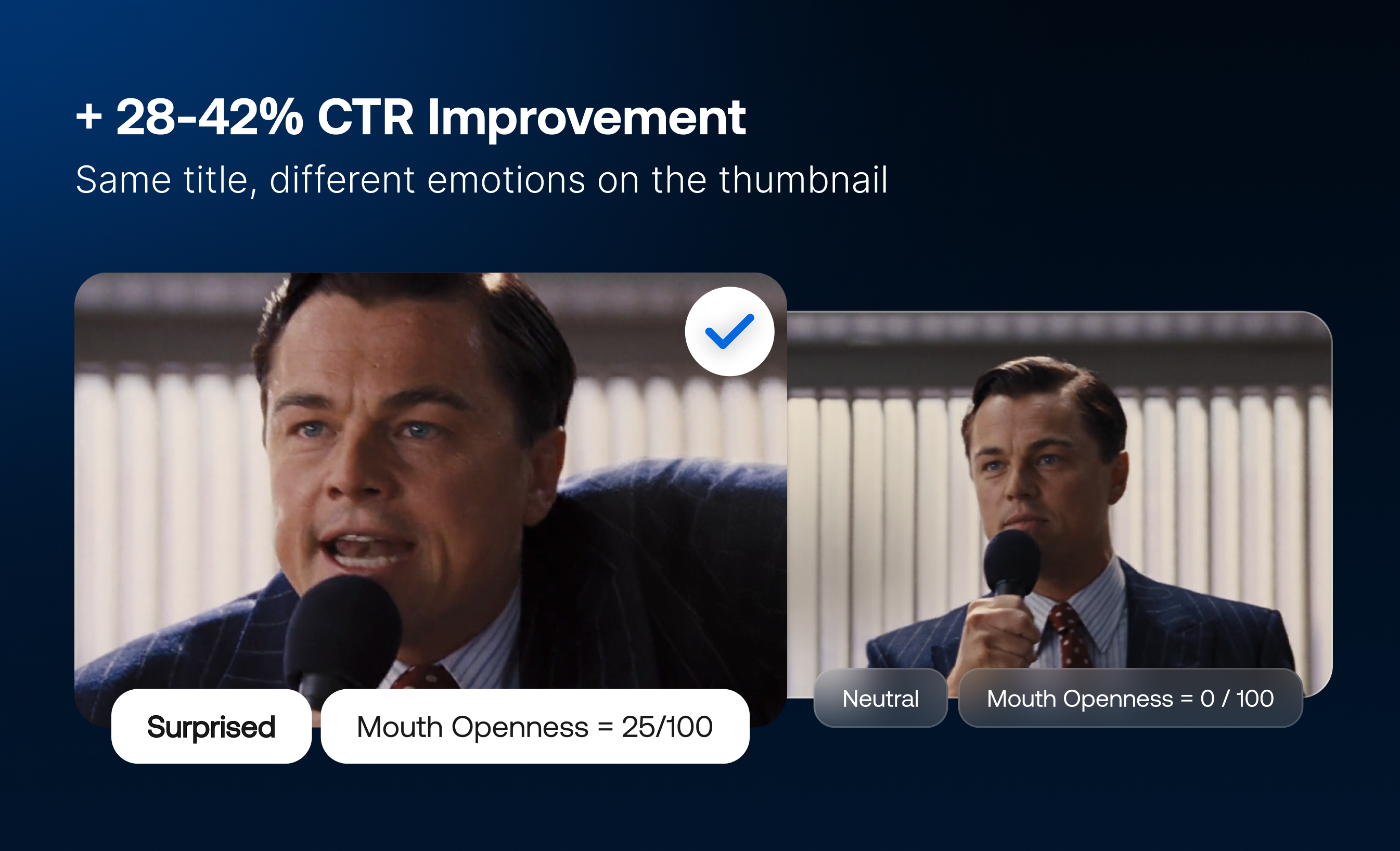
A 2024 analysis by VidIQ across millions of YouTube videos found that thumbnails featuring faces with strong emotional expression – shock, excitement, open-mouth surprise – increased CTR by 20–30% on average compared to thumbnails with neutral or composed faces. A separate TubeBuddy study of 1.2 million videos (November 2025) found emotional faces increased clicks by 42.3% overall.
The pattern is consistent with what Netflix's own research confirmed: emotional expression is one of the strongest predictors of click behavior on streaming thumbnails. The mechanism is neurological – high-arousal facial expressions activate the brain's threat-detection and curiosity responses before any conscious evaluation occurs. Vionlabs' emotion AI identifies precisely these peak-arousal frames automatically, across every asset in a library – not just the titles an editorial team has bandwidth to review.
Case Study 2 – Villain vs. Hero: A Pattern We See Across Our Client Base
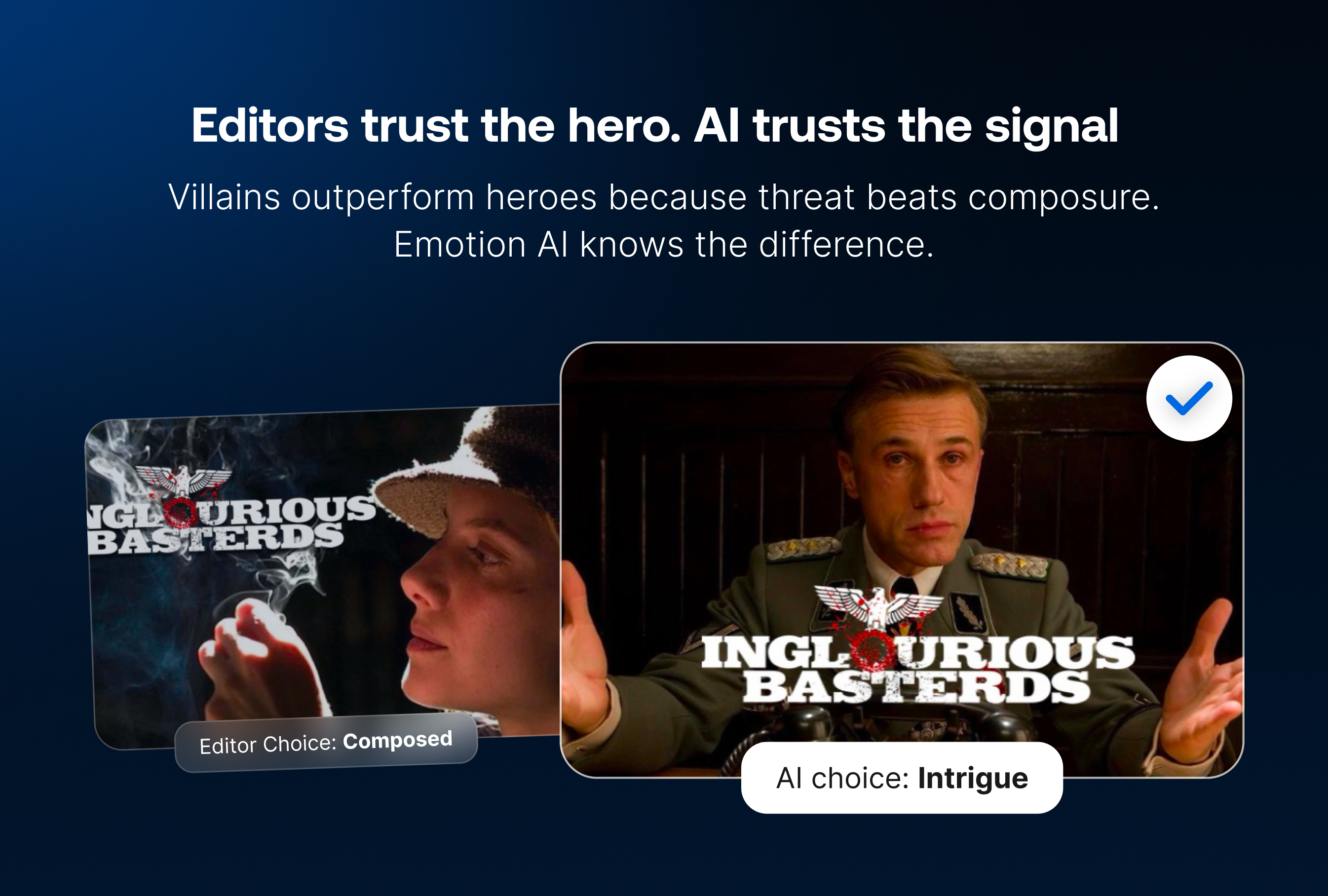
Netflix has disclosed that after testing billions of thumbnail variants, their system found that featuring a polarising character – typically a villain – “significantly outperformed” all other thumbnails, including those featuring the hero. This held true across both children's and adult content, and was especially pronounced in action and thriller genres (TechRadar / Netflix research disclosure).
This is a pattern Vionlabs sees repeatedly across our client base. In A/B tests on action and crime titles, frames featuring the antagonist at a moment of peak menace – cold expression, high dramatic tension – consistently outperform frames featuring the lead protagonist, even when the protagonist is the franchise's most recognizable face. A human editor defaults to the hero. Emotion AI defaults to the frame with the strongest signal.
Why? The villain frame carries unresolved threat and intrigue. The hero frame, by contrast, often signals resolution and composure – low emotional arousal. Viewers are not looking for comfort when choosing what to watch. They are looking for something to be intrigued by.
Case Study 3 – Same Title, Different Emotional Entry Point: The Personalisation Signal
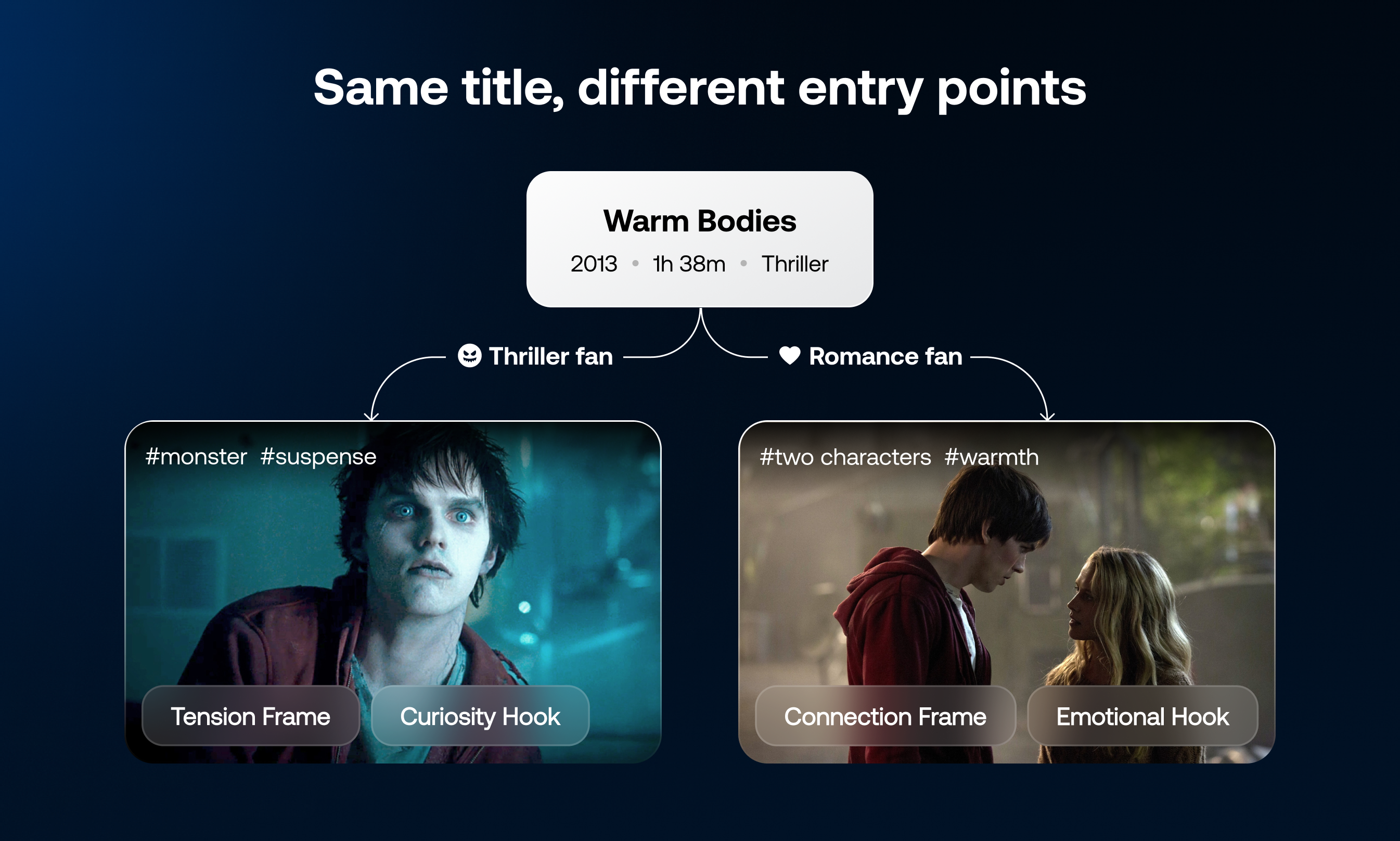
Netflix's AVA system – their internal AI for frame annotation and thumbnail selection – tags every frame with metadata including facial expression, character identity, shot scale, and emotional content. Independent research by QUT (Eklund, 2022) documented that Netflix shows dramatically different thumbnails to different users for the same title: one viewer sees a monster and tension; another sees a mother and emotional connection. Same content. Entirely different emotional hooks.
Netflix estimates viewers spend just 1.8 seconds considering each title – and will abandon browsing entirely within 90 seconds if nothing connects. In that window, the emotional signal of the thumbnail is the only thing doing the work. Matching the emotional entry point of the content to the emotional profile of the viewer is not a marginal optimisation – it is the core mechanism by which Netflix's recommendation engine converts browsing into watching. Most platforms do not have the AI layer to identify which frames carry which emotional signals. That is precisely the gap Vionlabs fills.
Before and after: what changes when you deploy emotion AI
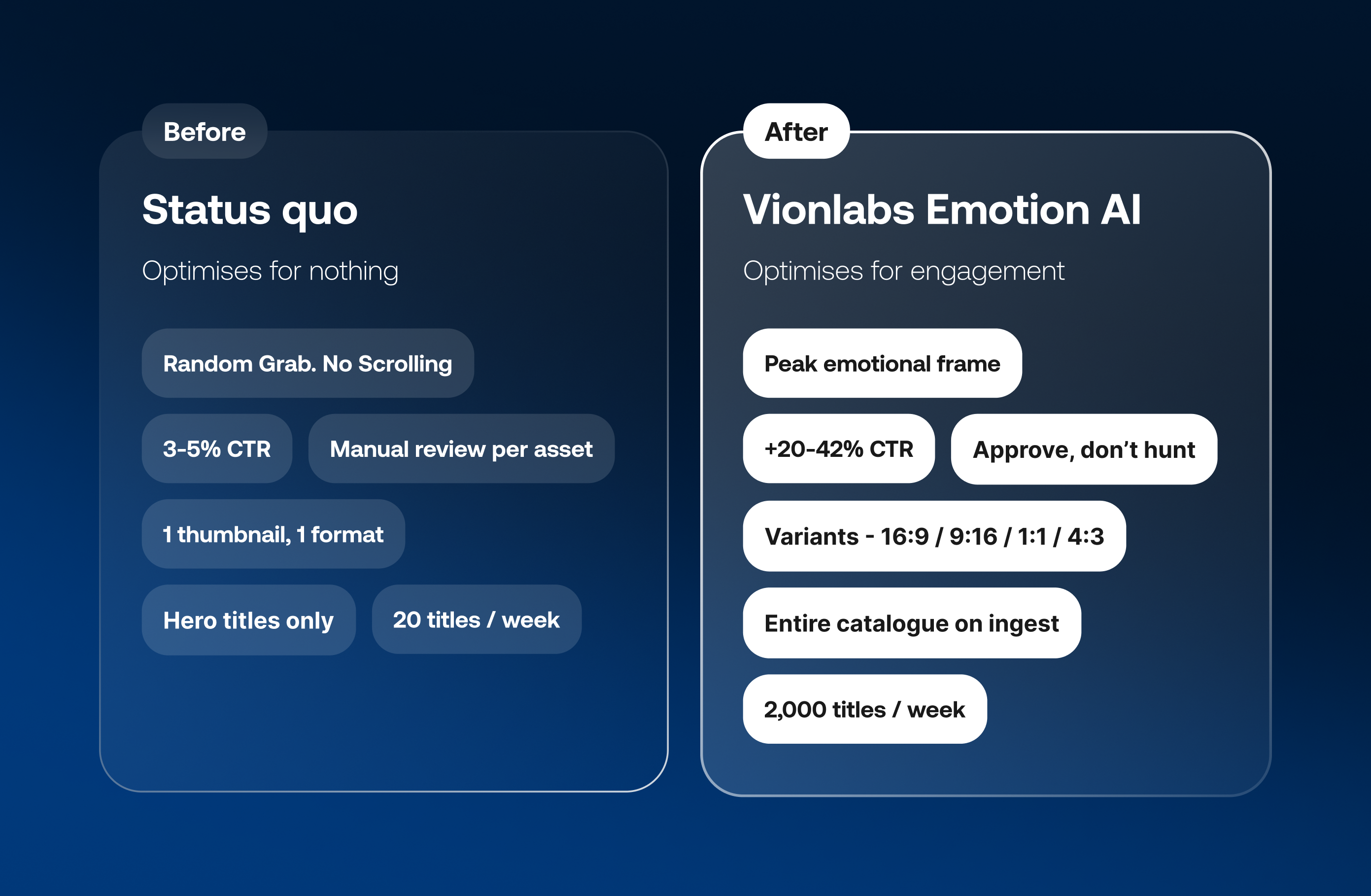
The table below maps the full impact across seven operational and creative dimensions – from frame quality and CTR through to team productivity, device coverage, and library-wide scale. Each row tells the same story: the status quo optimizes for nothing, and emotion AI optimizes for everything that actually drives engagement.
Thumbnail recipes: extracting frames by intent, not by rule
One of the most powerful features of Vionlabs' approach is the concept of thumbnail recipes – the ability to extract frames based on specific creative intent rather than timestamp. Instead of asking 'what is frame 847?', you ask:
“Give me the most emotionally intense romantic scene frame for this title.” | “Extract the peak action beat from episode 3.” | “Find all frames where Character X is shown in close-up with high emotional arousal.”
The data points Vionlabs extracts include:
Emotion Recipes: Romantic peak moments; high-tension action beats; comedic reaction shots; villain reveal frames; emotional climax scenes.
Scene & Character: Specific character filters; ensemble vs. solo framing; hero vs. antagonist performance; facial expression intensity; body language signals.
Format & Context: Mobile-optimized crops (9:16); portrait vs. landscape safe zones; text-safe regions for overlays; genre-appropriate color mood; brand consistency scoring.
Mobile-first: the vertical format imperative
Streaming consumption on mobile is growing rapidly – and mobile is not just a smaller screen, it is a fundamentally different format. The dominant mobile experience is vertical: 9:16, portrait orientation, full-bleed imagery in a narrow column. A thumbnail optimized for a 16:9 desktop tile often fails entirely in a vertical mobile environment – key faces are cropped, emotional cues disappear, the frame loses its signal.
Vionlabs' thumbnail extraction natively supports vertical format outputs, ensuring that emotionally salient frames are cropped and composed correctly for mobile surfaces – including app homescreens, vertical carousels, push notification previews, and social sharing. This means the same AI-identified emotional peak can serve both your desktop experience and your mobile experience simultaneously, with format-appropriate framing.
Scale, personalization, and the Netflix benchmark
Netflix has published research showing that personalized, emotionally salient thumbnails drive meaningful increases in click-through rates. Their approach: maintain hundreds of thumbnail variants per title – different emotional framings, different character prominence, different scene contexts – and serve the right variant to the right user based on their viewing history and preference signals.
The underlying insight is powerful: the same title has different emotional hooks for different viewers. A subscriber who watches a lot of thrillers should see the tension frame. A subscriber who watches romance should see the emotional connection frame. Personalized thumbnails are not about aesthetics – they are about matching the emotional entry point of the content to the emotional profile of the viewer.
Most platforms lack the AI layer to identify which frames are emotionally salient in the first place – let alone to generate and manage hundreds of variants per asset across a library of thousands of titles. Vionlabs is built specifically to close that gap.
Why this matters for long-tail and archive content
Hero titles get attention. Long-tail content – older seasons, archive films, niche catalogue – rarely gets manually reviewed for thumbnail quality. Yet these titles often represent the majority of a library by volume, and underperforming thumbnails across the long tail mean systematically lower engagement on the assets that need the most help. Vionlabs processes every asset in the library – not just the top 100 – ensuring that high-quality, emotionally optimized thumbnails exist at every level of the catalog.
Three use cases – one underlying capability
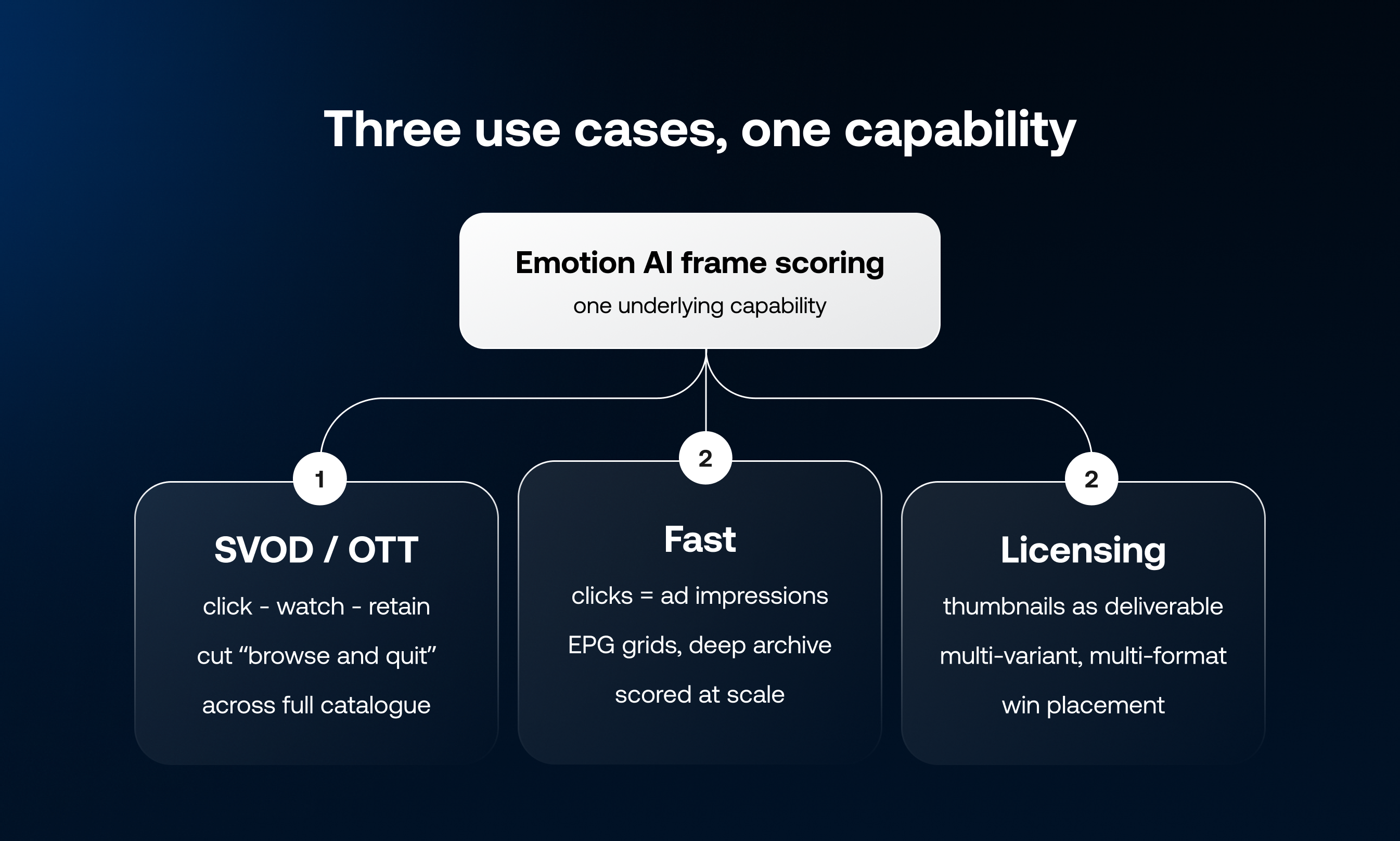
Thumbnail quality is not a single-audience problem. The same AI infrastructure that drives click-to-play on an SVOD platform also solves distinct and high-value problems for FAST operators and content owners licensing their catalogues. Here is how each use case plays out.
01 – SVOD / OTT: Drive engagement, watch time, and retention
The thumbnail is the entry point to every play. On a competitive OTT platform, where U.S. adults now average over 3 hours of streaming daily (Nielsen, 2025) and churn is driven by failure to find content worth watching, every click-to-play decision matters. A viewer who clicks is a viewer who watches – and watch time is the metric that determines algorithmic promotion, retention, and ultimately subscriber LTV.
Why thumbnails connect directly to retention: Netflix reports 82% of viewing decisions are thumbnail-driven; viewers who find content they intend to watch stay subscribed 43% longer (Uscreen); content completion rates above 80% signal algorithmic favor and reduce churn risk; emotionally salient thumbnails reduce 'browse and quit' sessions – the 90-second abandonment window Netflix has documented as the primary engagement failure mode.
Vionlabs enables platforms to deploy emotionally optimized thumbnails across their full catalogue – not just new releases – ensuring every title, including long-tail and archive content, has the best possible chance of converting a browse into a play.
02 – FAST Channels: Maximize ad inventory through stronger content discovery
FAST is scaling rapidly: total viewing hours across major FAST services surged 43% year-over-year to August 2025 (Comscore). Pluto TV, Tubi, and The Roku Channel now collectively reach around 111 million monthly U.S. viewers. U.S. FAST ad revenues are projected to reach $12 billion by 2027.
The FAST thumbnail problem: FAST platforms live and die by engagement. Ad revenue is a direct function of viewing hours – and viewing hours start with a click. FAST EPGs and channel guides are thumbnail-heavy surfaces: a viewer scanning a grid of 20+ channels makes decisions in under two seconds per tile. Weak thumbnails mean lower channel selection rates, shorter session duration, and fewer ad impressions served.
70% of FAST users say they can always find something to watch (Xumo/FASTMaster 2024) – the platforms that achieve this are the ones with the strongest content presentation. FAST channel catalogs are often deep archive content – precisely the assets that never received manual thumbnail attention. Vionlabs processes archive catalogues at scale, giving FAST operators emotionally scored thumbnails for every piece of programming in their grid.
03 – Content Licensing: Package assets to win distribution deals and platform placement
For studios, distributors, and independent content owners, licensing negotiations increasingly depend on the quality of the full asset package delivered to buyers. A buyer – whether a streaming platform, a FAST operator, or a broadcaster – evaluates content in two ways: the story it tells, and how well it can be surfaced to their audience.
Thumbnails are now a licensing deliverable: Platforms acquiring content increasingly expect curated thumbnail packages – multiple variants, multiple formats – as part of the delivery spec. Genre-specific variants (action peak, romantic moment, character close-up) allow buyers to match the emotional hook of your content to their audience profile. Device-ready outputs (16:9, 9:16, 1:1, 4:3) remove integration friction for buyers across Smart TV, mobile, EPG, and social surfaces. A well-packaged asset stands out in a pitch: buyers can immediately visualize how it performs on their platform, increasing placement likelihood and negotiating leverage.
Vionlabs enables content owners to deliver professional, AI-scored thumbnail packages at the point of licensing – transforming a raw asset delivery into a distribution-ready product.
How Vionlabs deploys – on-prem, Creative Lab, and API
Vionlabs is designed to integrate with your existing content infrastructure without requiring data to leave your environment. The AI is deployed on-premise within your own cloud or data center – your content never touches an external server, ensuring full compliance with content licensing agreements and data sovereignty requirements.
Creative Lab: A purpose-built interface for your creative and editorial teams. Browse emotionally salient frames, apply thumbnail recipes, preview mobile crops, and export at scale – without touching a line of code. Designed for the people who actually make creative decisions.
REST API: Full programmatic access to all thumbnail extraction and emotion scoring capabilities. Automate thumbnail generation across thousands of assets, integrate with your CMS or DAM, and build personalisation pipelines that serve variant thumbnails based on user profiles. Scales to millions of assets with no manual intervention.
Library-Wide Processing: Vionlabs processes your entire catalogue on ingestion – not just new content. Every asset, every episode, every archive title receives emotion-scored thumbnail candidates automatically. Your team works with the output, not the raw footage.
See how Vionlabs identifies your best-performing frames
Across your whole library – hero titles, long-tail, archive. Takes minutes to demo.
.png)
.png)



