
Point a general-purpose AI model at a video and it will tell you what's in it, with impressive precision. Two people in a dimly lit room, a table between them, a full transcript of every word spoken, an accurate description of the setting. Object recognition, speech-to-text, scene description: these are largely solved problems, and solved well. In just a few years, these models have gone from labeling objects in a still frame to answering open-ended questions about an entire video, generating detailed scene summaries, and retrieving exact moments across libraries containing hundreds of thousands of hours of content.
Ask the same model what the scene actually means, and it has nothing.
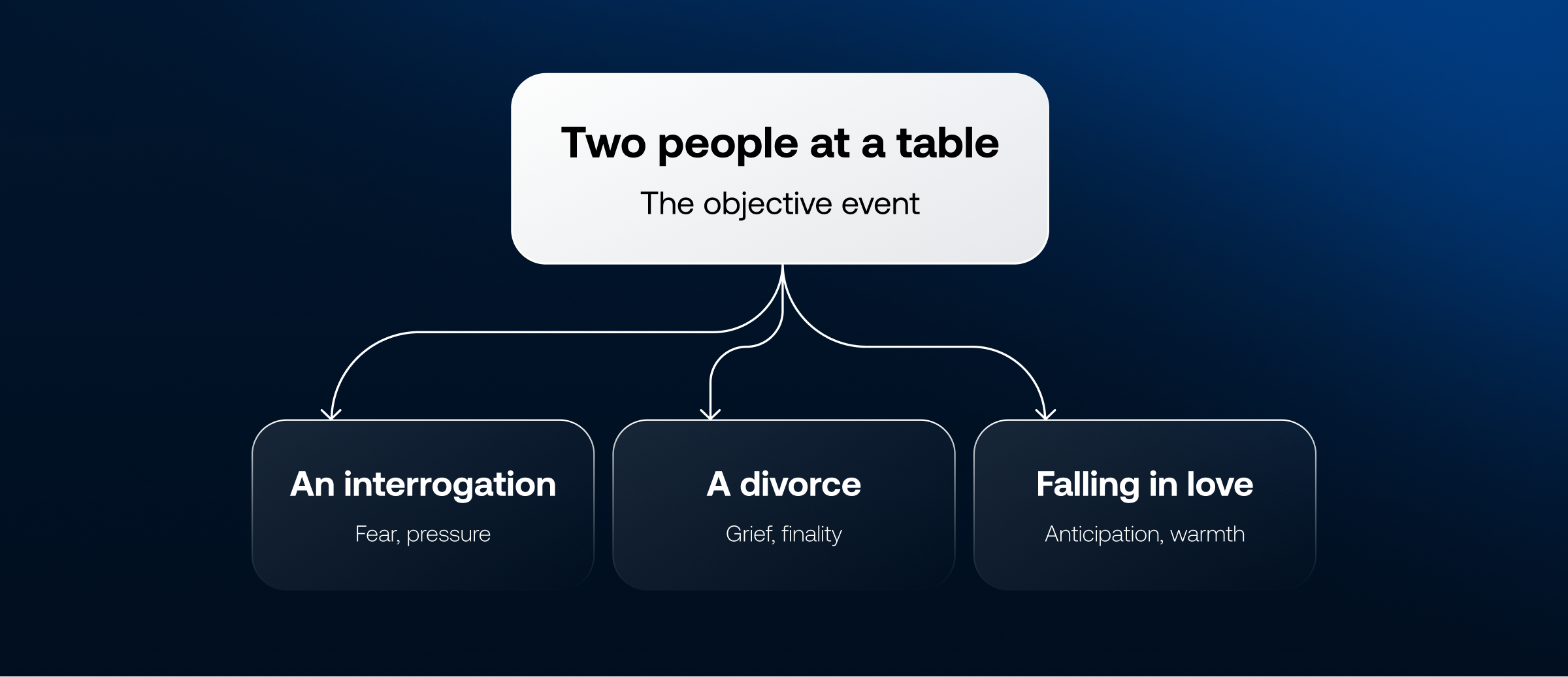
Is this the end of a marriage or the beginning of a romance? Is the tension building or releasing, compared to the scene before it? Is this the moment the audience is meant to lean in, or exhale? Has the relationship between these characters been building for three seasons, or are they meeting for the first time? Should the audience be hoping this character succeeds, or fearing it? A general model can't answer any of that, for the simple reason that the answer was never encoded in an object, a facial expression, or a line of dialogue. The answer lives in the relationship between dozens of things happening at once, often across several scenes and sometimes across an entire season. That's a fundamentally different problem than the one most video AI models are built to solve, and it becomes visible exactly where it matters most: where content meets audience.
That distinction sounds academic until you try to run a media business on top of it. Recommendation engines, editorial teams, archive licensing desks, ad sales, and marketing all depend on understanding what a scene is doing to an audience, not just what's visible inside it. Get that wrong, and the metadata looks complete on paper while remaining useless for the workflows that actually matter: search, recommendations, editorial curation, and monetization.
What exists today, and why it falls short for entertainment
Over the last decade, progress in video AI has largely been driven by models built to generalize. The idea is simple, and commercially attractive: one architecture should be able to analyze a surveillance clip, a football match, a corporate meeting, and a news broadcast, using the same weights and the same basic understanding of "what's happening on screen." A vendor can sell a single model to a security team, a government agency, a sports organization, and a media company, and in every case deliver impressive results on baseline recognition: objects, people, event sequences, speech.
This isn't a weakness. The general-purpose approach is the right solution for a large number of use cases. A security platform needs to understand physical events consistently, regardless of environment, lighting, or camera angle: is someone climbing a fence, is a bag left unattended, has a door opened that should be closed. A government agency analyzing surveillance or archival footage needs objective identification of people, vehicles, and event sequences, searchable and consistent across millions of hours, with no need to interpret any underlying "feeling" in the material. Sports analysis needs to identify goals, phases of play, players, and tactical patterns with high precision across entire seasons. In every one of these cases, the goal is to document and categorize reality as precisely as possible. That's the task the model is trained for, and that's why it performs well there.
Several players on the market today have built exactly this kind of broad, powerful video model, with the explicit ambition that one model should handle search and understanding across wildly different use cases: security monitoring, government archives, media libraries, ad inventory, sports clips, all inside a single product. That's impressive engineering, and for many of those use cases it's the right solution, because the buyer primarily wants broad coverage, fast integration, and consistent performance across many content types, rather than deep interpretation of any one type in particular.
But that breadth comes at a cost, and the cost shows up most clearly in entertainment. A model optimized to perform "well enough" across ten different industries rarely ends up being the best model for any single one of them, for the same reason a generalist physician is rarely the best surgeon for a complex procedure. The broader a system is built to work, the more of its capacity goes toward handling variation across industries, and the less is left over to go deep on any one of them.
Entertainment is where this gap shows up most starkly, for a simple reason: it's the only category of content where the entire point is the emotional experience, rather than the objective event. A surveillance camera is meant to document reality as neutrally as possible. A film is meant to do the opposite: it deliberately manipulates how you experience a sequence of events, through light, sound, editing, pacing, and dramatic structure, to create a feeling that doesn't naturally exist in the raw event. Two people sitting and talking at a table are, from a purely objective standpoint, an identical event whether it's an interrogation, a divorce negotiation, or two people falling in love. It's exactly that distinction that a general model, trained to generalize across news, sports, surveillance, and meetings, never gets the chance to learn, because that pattern isn't represented in sufficient volume in that kind of training data.
This is also why a model that performs excellently on security footage, government archives, or sports clips doesn't automatically perform well on entertainment, even though marketing from the broad-model vendors often implies otherwise by listing "media and entertainment" as one supported use case among many. A model can correctly identify what's visible in a film scene, generate an accurate transcript, and describe the setting with high precision, and still miss almost everything that's relevant to how the scene should be understood, searched for, or recommended. That's not a sign of a bad model. It's a sign of a model solving the wrong problem, however well it solves it.
What it actually takes to understand entertainment content
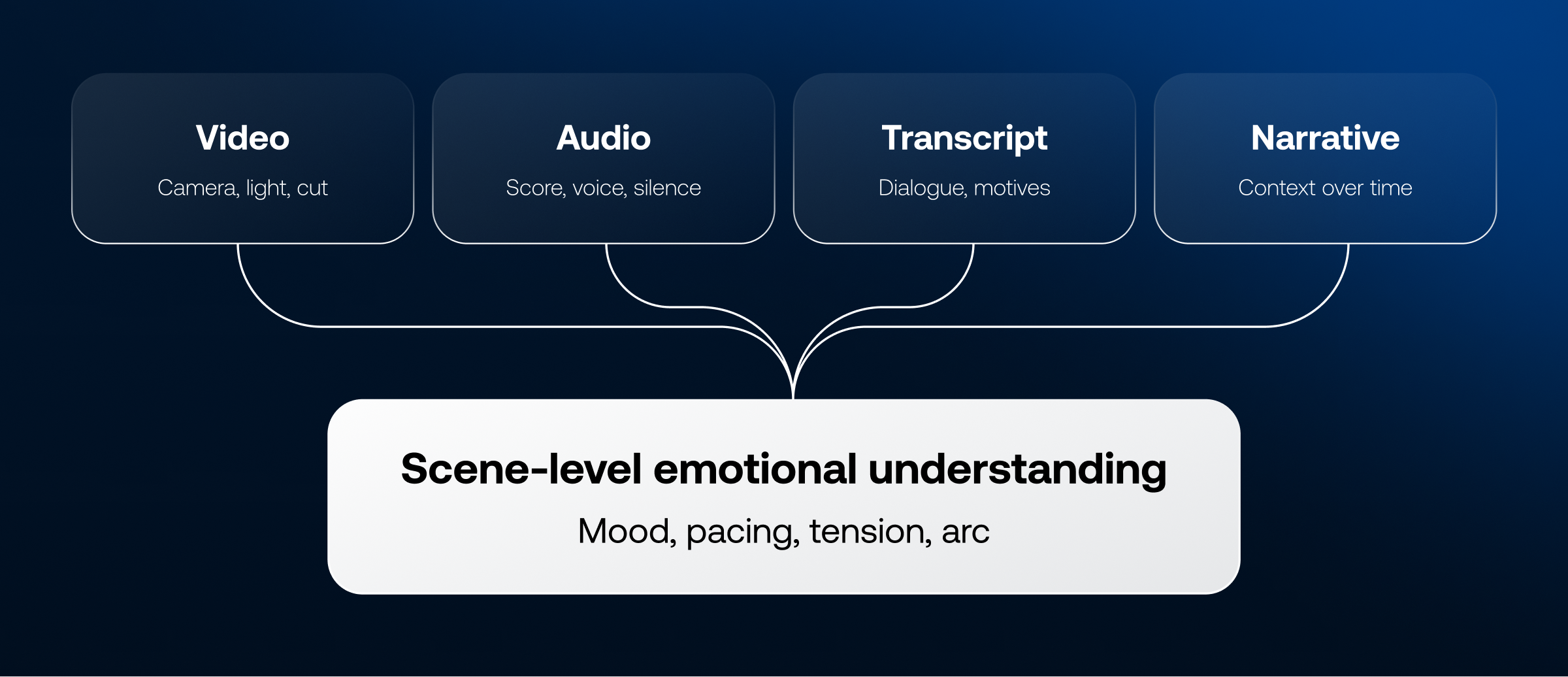
Understanding a piece of entertainment content requires more than combining a vision model and a language model and hoping that's enough. It requires extracting and combining emotional information from several distinct layers, simultaneously, because none of them on their own produces a complete picture. This is architecturally a different task than general video understanding, not simply a matter of adding more training data to the same base model.
The video layer
The video layer carries meaning that goes far beyond what's literally visible in the frame. Camera work creates anticipation before the action has caught up. Close-ups create intimacy, wide shots create distance and isolation. Editing rhythm determines whether a sequence feels calm or chaotic, slow or frantic. Lighting, color grading, composition, facial expression, and body language all contribute subtle signals that, together rather than individually, shape how an audience interprets a moment.
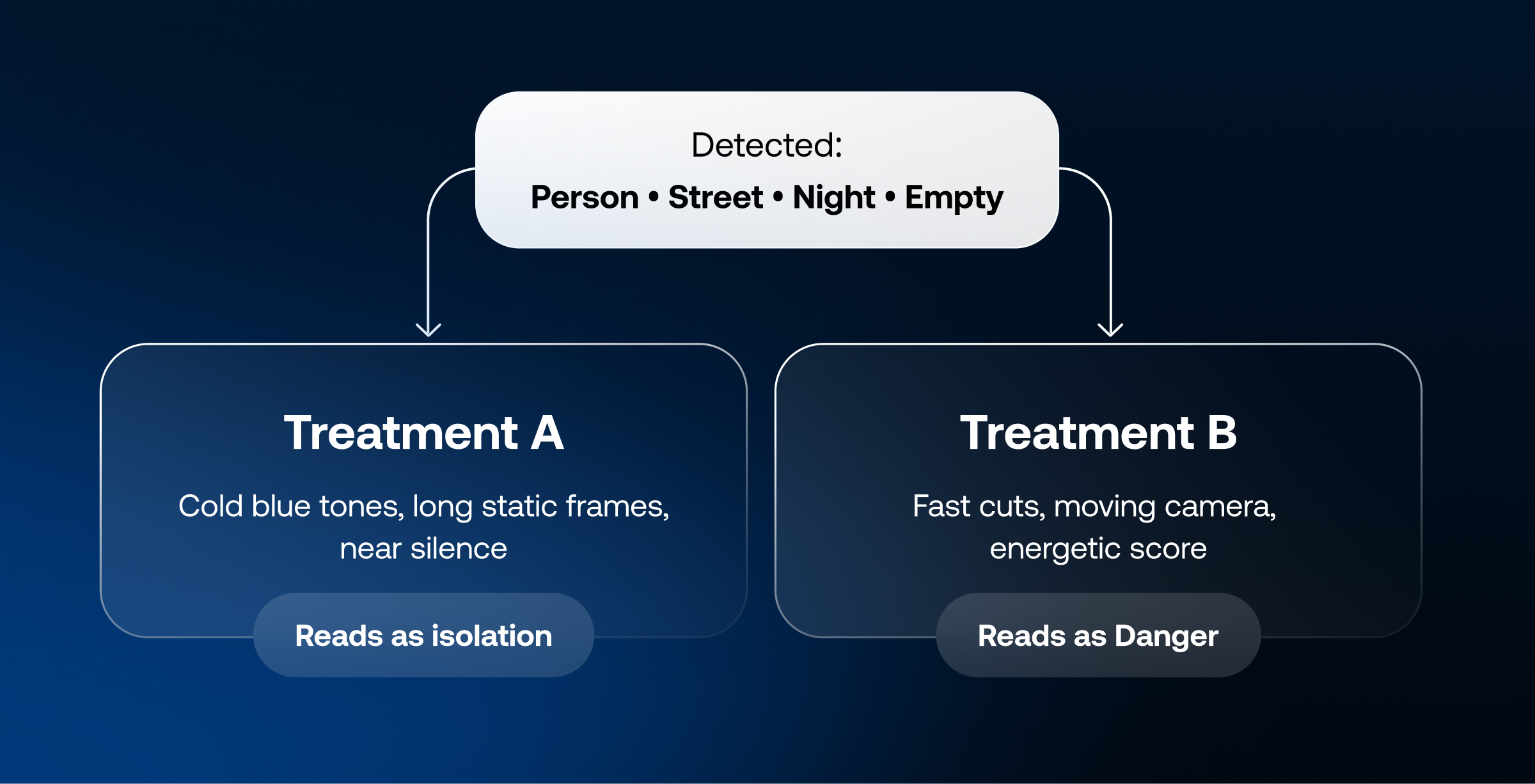
Take two scenes with an identical action: a person walking alone down an empty street at night. Object detection returns the same result for both: person, street, night, empty. But one scene is shot in cold blue tones, held on long static frames with almost no sound, and reads as isolation and vulnerability. The other cuts fast, moves the camera constantly, and layers in an energetic score, and reads as danger, excitement, or a chase about to begin. Nothing in the frame has changed. Everything the frame means has changed, and that shift happens entirely through visual choices that an object detector, by definition, isn't built to read.
The audio layer
The audio layer often carries more emotional information than the picture does, which is one of the more underappreciated parts of entertainment understanding. A rising orchestral swell creates anticipation before anything has happened on screen; the audience is primed emotionally before the plot gives them a reason. A restrained piano piece can create intimacy or melancholy long before the dialogue confirms it. Silence, frequently overlooked in traditional video analysis, can be a director's most powerful tool. Removing the score before an important conversation immediately changes how an audience perceives the moment: tension rises, and attention is forced onto every pause and every spoken word.
The voice itself carries information that no transcript can capture. Two characters can say the same line, but pitch, pace, breath, hesitation, and vocal energy are where sarcasm, fear, confidence, sorrow, and relief actually live. All of that disappears the instant speech becomes text, no matter how accurate the speech recognition is.
The transcript layer
The transcript layer still matters, but it should be treated as one layer among several rather than the complete representation of a scene. Dialogue explains relationships, motivations, and how a conflict evolves over time, giving a model the ability to understand who the characters are, what they want, and how their relationships change. But entertainment is full of moments where meaning is deliberately left unspoken. Characters communicate through silence, glances, and visual storytelling just as often as through dialogue, and understanding those moments requires combining narrative context with every other layer, rather than treating the transcript as the primary source of truth about what a scene is about.
Narrative context over time
Beyond these three layers sits a fourth element that's rarely present within any single scene, yet often determines how that scene should be interpreted: narrative context over time. A hug means very little viewed in isolation. Viewed as the payoff of a conflict that's been building across eleven prior episodes, it becomes one of the most powerful moments in the season. A seemingly ordinary dinner conversation can become deeply uncomfortable to watch, not because of anything happening in the scene itself, but because the audience already knows something one of the characters doesn't.
Most video models process clips independently, extracting what they can from each segment on its own, largely because that's the most tractable engineering approach for general video understanding at scale. Storytelling doesn't work that way. Tension builds gradually. Relationships evolve across episodes. A scene's emotional weight is frequently determined entirely by what happened earlier in the story, not by anything visible in the scene itself, and a model with no mechanism for tracking those long-range dependencies will misread the scene every time, no matter how well it analyzes it in isolation.
Why this is so hard, and why training data is the whole point
Combining these four layers sounds straightforward in theory: analyze the picture, analyze the audio, analyze the text, weight the results together. In practice it's one of the hardest problems in multimodal AI, for a simple reason. None of the signals are unambiguous on their own, and their relative meaning shifts constantly depending on context. A rising pitch in someone's voice can signal anger in one scene and excitement in another. Fast cutting can signal danger in one scene and comedy in another. Music that stops can mean grief in one context and a comedic beat in another. There's no fixed rulebook a model can memorize. There are only statistical patterns that recur again and again in this specific type of content, in these specific combinations, and those patterns have to be learned through exposure to a large amount of exactly that kind of material.
This is precisely why general training data can never substitute for domain-specific training data on this problem, regardless of how much general data gets fed in. Internet video, meeting recordings, sports broadcasts, surveillance footage, and news clips never teach a model professional storytelling craft. Rising action, deliberately planted turning points, intentional shifts in pacing: these patterns are extremely common inside film and television, and nearly absent from almost everything else that general-purpose models are typically trained on. A model that has rarely encountered those patterns during training won't recognize them at inference time either, no matter how large or powerful it is.
This is the same logic that's already established in other specialized applications of AI. A model optimized for medical imaging learns different visual representations than one optimized for satellite imagery, even though both are analyzing images. A language model trained specifically on legal text outperforms a general model on legal tasks, even if the general model has technically seen more text overall. Nobody expects a general-purpose language model to seamlessly replace a model specialized for, say, pharmaceutical documentation, precisely because specialization in that domain matters for output quality.
Entertainment needs exactly the same thing, though the industry still doesn't always treat it that way. Models trained from the ground up on film, television, and premium content learn representations that prioritize emotion, narrative development, and storytelling craft, rather than simply recognizing physical events. This isn't a matter of bolting a new capability onto an existing general model, or fine-tuning a general model with a bit of extra film data at the end. It's a matter of changing what the model learns to represent from the very first training step, which in practice means building and training the models specifically for this type of content, rather than repurposing a model already optimized for a different objective.
From emotional understanding to searchable content intelligence
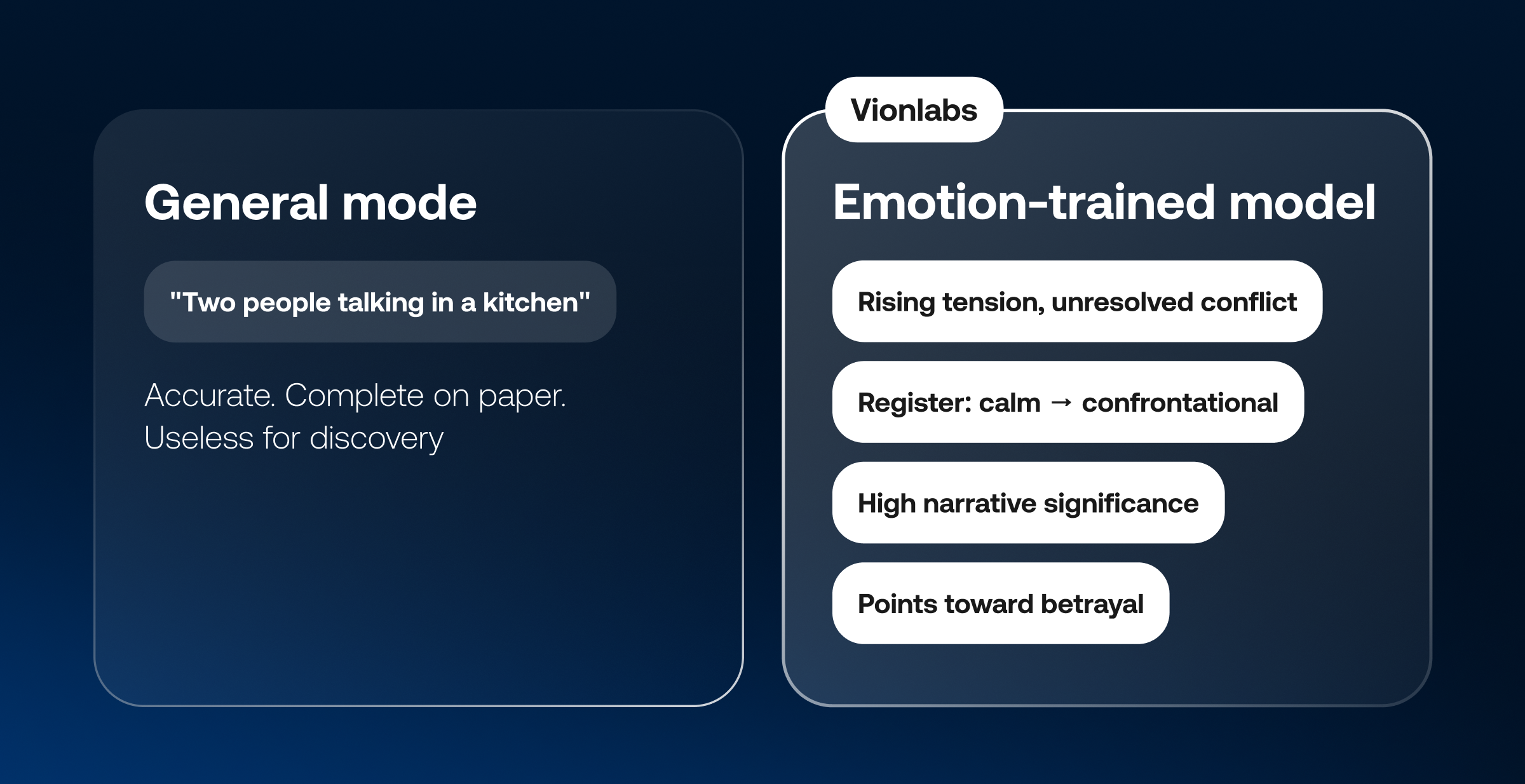
Once a model has actually been trained to understand mood, pacing, and narrative development, rather than just what's visible in a frame, the entire output changes. Instead of "two people talking in a kitchen," you get something closer to: rising tension, unresolved conflict, an emotional register shifting from calm to confrontational partway through the scene, high narrative significance relative to surrounding scenes, a tone that points toward betrayal rather than reconciliation. None of these are manually assigned categories from a fixed dropdown. They're derived continuously from how visuals, audio, dialogue, and narrative context interact throughout the content, scene by scene.
This kind of continuous, comparable representation unlocks several things that traditional metadata, however extensive, has never been able to deliver.
Mood-based content discovery
.png)
Instead of just describing what a piece of content contains, the system can describe what it feels like to watch, which makes it possible to find content based on combinations that never existed as a manual tag and that no human cataloguer could realistically tag by hand across an entire library. Consider queries like "love affairs that escalate into revenge," "romantic relationships that build slowly but end in betrayal," "family conflicts with rising emotional tension that ultimately land on reconciliation," or "underdog stories where the protagonist is counted out but turns everything around by the end, whether it's sports, courtrooms, or the music industry." This isn't genre. It isn't a plot description in the traditional sense. It's an emotional arc with a specific shape, and that kind of query simply can't be answered with genre or keyword tags, however well maintained, because the information required to answer it was never captured in the first tagging pass.
With a model that genuinely understands emotional and narrative development, it becomes possible to search for exactly that kind of content across an entire library in seconds instead of weeks of manual review, and the result is consistent regardless of how old, obscure, or poorly tagged the content originally was, because the understanding is generated directly from the content itself rather than from whatever metadata happened to arrive with it.
Clips and thumbnails at the scene level
The same understanding can be applied directly at the clip and frame level, not just the title level, which is where much of the day-to-day editorial and commercial work actually happens. An editor building a trailer no longer needs to manually scroll through entire episodes to find "the most emotionally powerful reconciliation scene in the library" or "every moment where a character realizes they've been betrayed." A marketing team can search for every scene with a particular kind of late-afternoon melancholy, a specific adrenaline-fueled action rhythm, or a distinct tone of dark comedy, regardless of which title, genre, or era it comes from.
The same logic applies to thumbnails. Instead of defaulting to the first frame of a scene or a random midpoint capture, the system can identify the specific frame that best conveys the content's emotional promise: the image that actually makes someone stop scrolling and click, rather than one that simply happens to represent a technically valid second of the video. Multiplied across a library of thousands of titles, that's a measurable difference in how much of the catalog gets discovered and watched, because every title is suddenly presented at its best rather than left to chance.
When this kind of search and selection works at the scene and clip level rather than only the title level, it fundamentally changes the workflow for editorial, marketing, and catalog monetization, turning it from something that requires manual review of content people already know well into something that can cover the entire catalog, including the parts of the archive nobody remembers in detail anymore.
The impact: search and recommendations that actually reflect how people think
This is also where the biggest commercial value shows up, in both search and recommendations, for the same underlying reason: people rarely look for content the way traditional systems expect them to.
Very few viewers think in terms of genre, production year, or cast names when they're deciding what to watch. Instead, they describe, consciously or not, a feeling they want to experience right now. Someone searches for "something uplifting after a hard day," "a slow-burn psychological thriller," or "a romantic film with a bittersweet ending, not a happy one." These aren't object-based queries. They're descriptions of an emotional experience, phrased in everyday language, and answering them requires the AI to understand the feeling itself, not just the individual words that describe it.
The same logic applies to recommendations, though the mechanism looks a little different. Collaborative filtering, recommending based on what similar viewers watched, remains genuinely effective and isn't going anywhere, especially for popular titles with a lot of viewing history behind them. But it explains what people watched, not why they watched it, and that distinction matters more than it appears to at first.
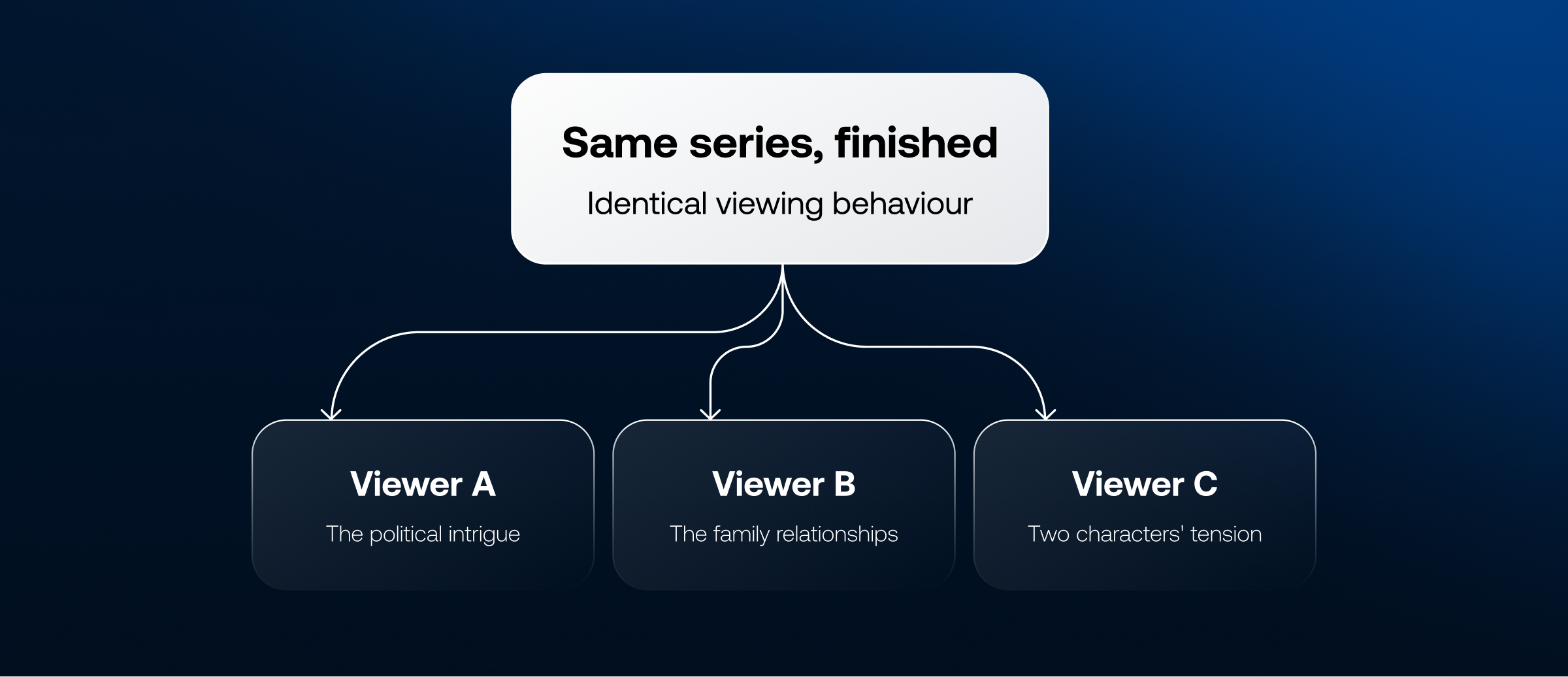
Two viewers can finish the same series for completely different reasons: one for the political intrigue, one for the family relationships, a third for the tension between two specific characters who never quite say what they feel. Looking only at viewing behavior, these three audiences look identical: same title, same completion rate, same platform. Their actual preferences can be almost entirely different, and a system that only sees the behavior has no way of telling them apart when the next recommendation gets made.
The same person also rarely wants the same emotional experience every day. Someone opening a streaming app on a Friday night is often looking for excitement and intensity. The same person on a quiet Sunday afternoon might instead be looking for something comforting, funny, or emotionally light, without necessarily being able to put that difference into words. Genre alone doesn't explain this shift, because it's often the same genre both times; what differs is the emotional register within it, not the category. Behavioral history alone doesn't predict it either, because it's a decision made in the moment based on mood, not a stable long-term preference that can be read off after the fact.
Emotional and narrative embeddings give a recommendation engine a signal that collaborative filtering structurally cannot produce on its own: not just what a title is, but what it's like to experience, independent of who has already watched it. That's particularly valuable for new titles or content deep in the catalog that has no viewing history to lean on, which is exactly the kind of content that otherwise risks never being discovered. The result is recommendations that feel significantly more relevant, simply because they match how people actually choose what to watch, rather than how a system happens to have structured its catalog. People rarely ask for "another crime drama." They ask for something exciting. Something comforting. Something emotionally engaging. Something that feels like the last film they loved, even if the next suggestion belongs to a completely different genre.
How Vionlabs does this
This is exactly the problem Vionlabs has been building for since 2019: proprietary models trained from the ground up specifically on film, television, and premium content, rather than general models adapted after the fact for one use case among many. The models analyze visuals, audio, and language together, not as separate, sequential steps stitched together afterward, to produce a scene-level understanding of mood, pacing, tension, and narrative development. Not a description of what a scene contains, but a representation of what it does to an audience.
In practice, that means a library can be searched with queries that resemble how an editor or a buyer actually thinks, rather than how a database happens to be structured. It means clips and thumbnails can be generated automatically based on emotional relevance rather than random frames, which is precisely the work Vionlabs' Creative Lab is built to handle at scale. It means editorial teams can curate and surface content through Editorial Lab based on mood and narrative rather than genre and keywords alone. And it means recommendation systems and contextual advertising can be built on top of embeddings that capture what a piece of content feels like to watch, not just what genre it's labeled as, which is the core of what Vionlabs' Operations Lab and Embeddings API deliver for partners connecting this kind of understanding into their own recommendation and ad systems.
This applies equally to newly produced content and decades-old archive titles, because the emotional and narrative understanding doesn't depend on external metadata, reviews, or prior viewing history to function. An obscure fifteen-year-old drama series that never got a marketing push can be understood, surfaced, and recommended just as effectively as a current flagship production, because the understanding is generated directly from the visuals, audio, and dialogue in the content itself, not from how well known or well documented it happens to already be.
This is also why "can it handle entertainment too" is the wrong question to ask about a broad video AI model, in the same way it would be wrong to ask whether a model trained primarily on satellite imagery can also handle medical diagnostics just because both are, at some level, image analysis. Breadth and domain-specific understanding are different goals, and they're rarely optimized for at the same time without some tradeoff. For entertainment, where the entire commercial value sits in the emotional experience rather than the objective event, domain-specific understanding isn't a nice-to-have at the bottom of a product list. It's the precondition for the metadata to be usable at all in the workflows that actually drive revenue: search, recommendations, editorial curation, archive licensing, and contextual advertising.
Why this is the shift worth paying attention to
For most of the last decade, progress in video AI has been measured by recognition accuracy: better face detection, better transcription, better object classification, better scene description. Those capabilities are necessary, and they've improved dramatically in a short time. But they've stopped being the limiting factor in what entertainment metadata can accomplish. The constraint today is interpretation: whether a system understands not just what happened in a scene, but what it was built to make an audience feel, and how that feeling connects to everything that happened earlier in the story.
That's the shift that determines whether a library becomes searchable the way editorial teams actually think, whether a recommendation engine can explain why someone loved a title and not just that they finished it, whether an archive can be licensed with the specificity buyers actually want, and whether a viewer finds exactly the feeling they were looking for that night, instead of just something adjacent on paper based on genre or cast.
Viewers don't remember the objects in a scene. They remember how it made them feel: the tension before a reveal, the relief when a conflict finally resolves, the warmth of a reunion they'd been waiting three episodes for. Metadata that can't capture that isn't describing what viewers actually get out of watching. It's describing everything around it, and leaving out the part that matters.
See how scene-level emotional and narrative understanding changes search, recommendations, and monetization across your library.
.png)
.png)